![Chiba Lotte Marines pitcher Naoya Masuda [Photo: Provided by the team]](https://media.insight.pacificleague.com/webp/UXSyQhUfQavnSXX3AhJSQ96WuwvXD1YXE8NSNOZm.webp)
Even after reaching the major milestone of 250 saves, he has continued to take the mound and is now closing in on a new monumental achievement.
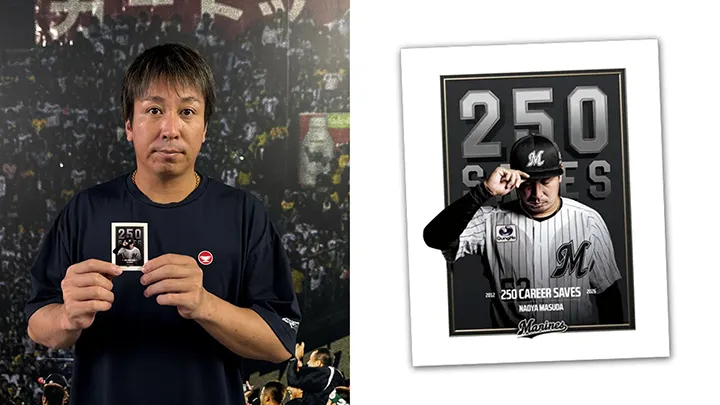
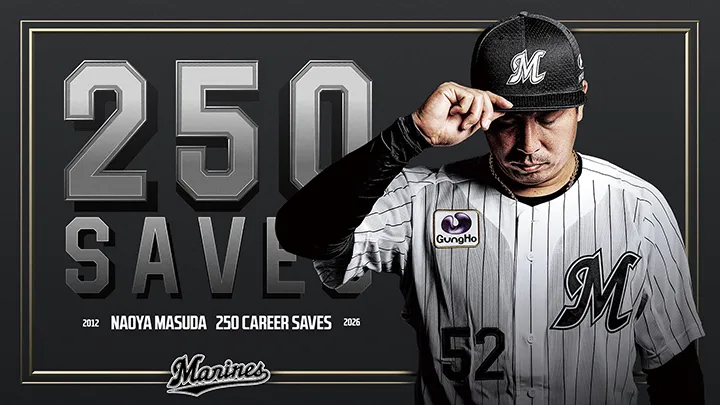
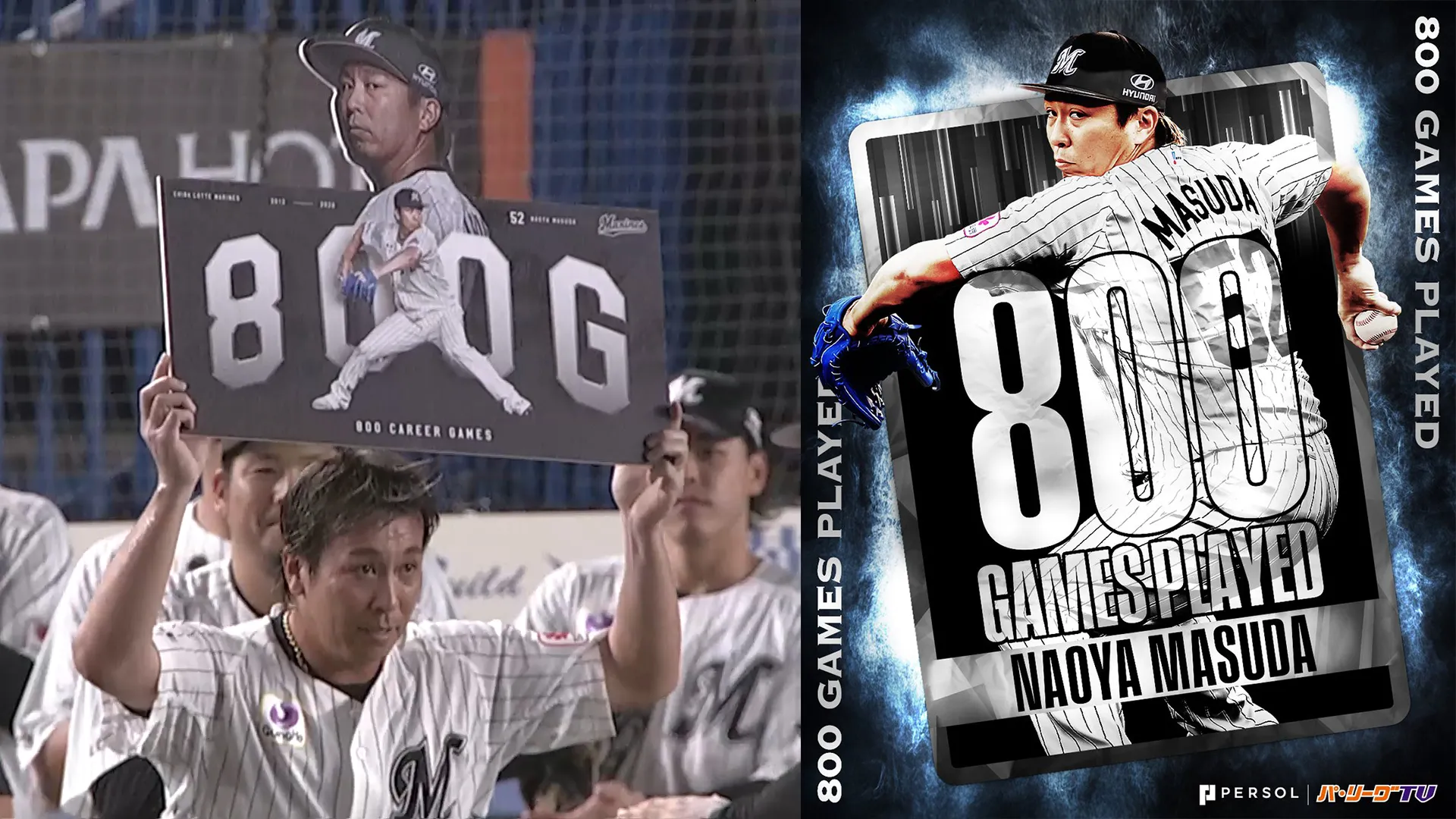
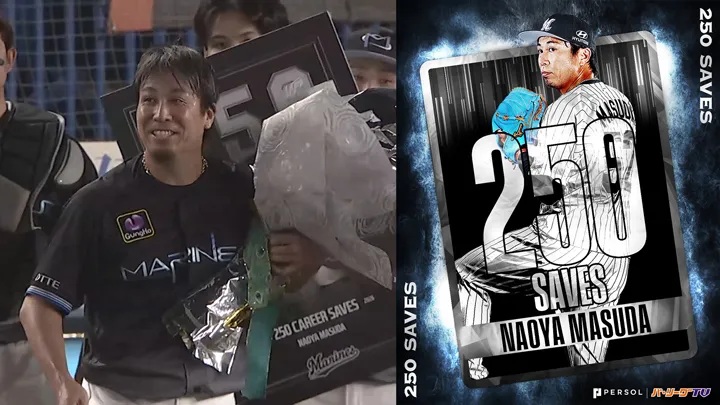
Chiba Lotte Marines Naoya Masuda pitcher achieved the remarkable milestone of 250 career NPB saves on August 4, becoming the fifth player in history to do so. Furthermore, after entering the world of elite baseball, he continued to pitch steadily, and on August 26, he reached 800 NPB games pitched—a feat previously held by only eight players.
Although he struggled with a ERA 4.35 last season, pitcher Masuda made a remarkable comeback with indomitable spirit. This time, we will look back on the career of the iron arm who made his mark in baseball history, and also delve into why he regained stability in 2026 based on various metrics he has recorded so far. (*Records are as of the end of games on August 26)
Starting just before his 30s, he worked at full capacity as a closer and rapidly climbed the ladder toward induction into the Meikyukai.
The various statistics recorded by pitcher Masuda to date are as follows.
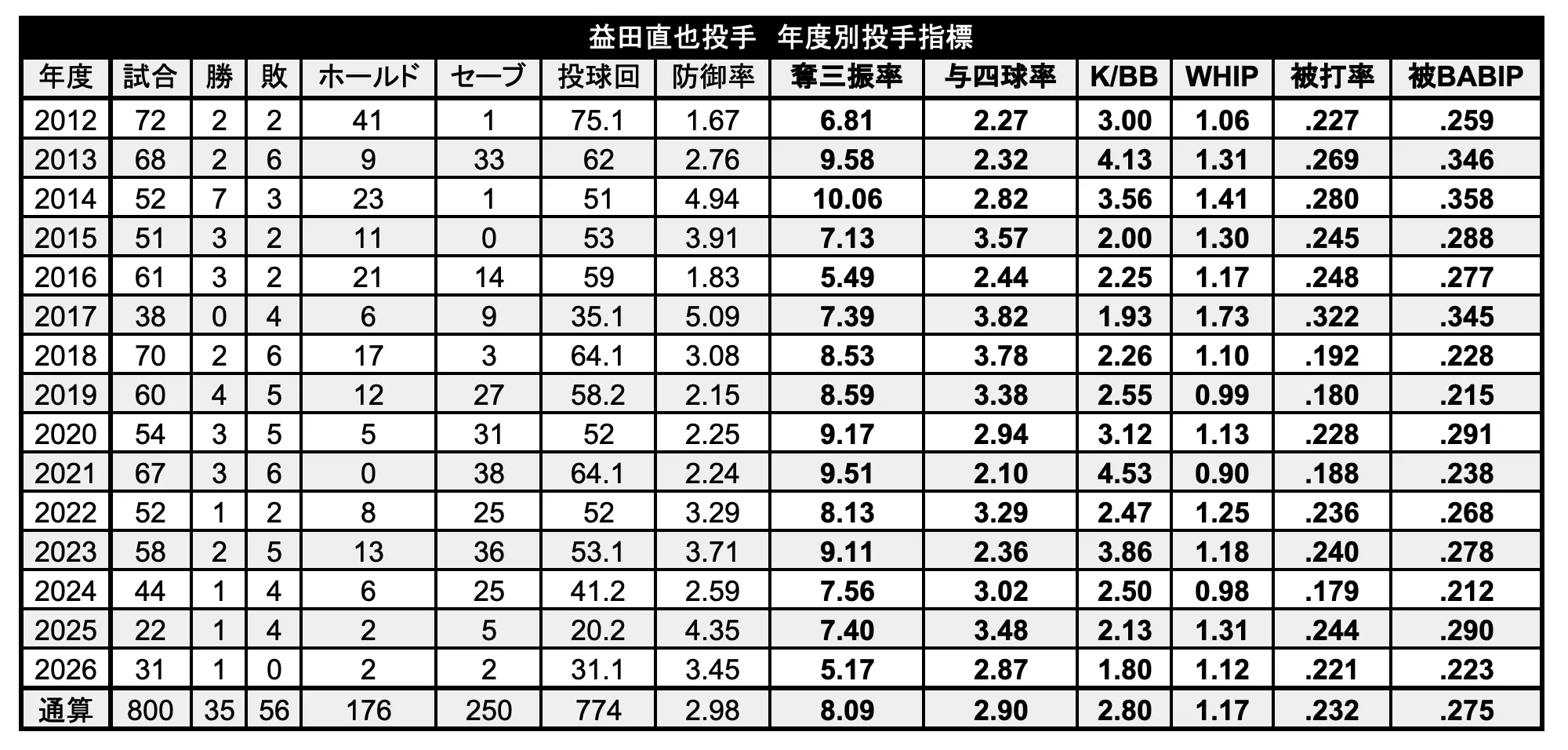
In his rookie year in 2012, he made a record 72 appearances for a rookie in NPB history, pitch 41 hold and an impressive 1.67 ERA, earning him the Rookie of the Year title. The following year, 2013, he was quickly entrusted with the important role of closer, and he recorded 33 saves, winning the saves title.
He continued to make numerous appearances as one of the key players in bullpen, pitching in over 50 games for five consecutive seasons from his rookie year. On the other hand, in the early stages of his career, he was often used as a setup man, and the number of saves he recorded in his first seven years was limited to 61.
However, in 2019 he returned to his position as closer and recorded 27 saves, going on to record 182 saves over the next six seasons. In 2021 he won the most saves title for the second time in his career, and he significantly increased his save total after turning 30. His career trajectory, which showed no signs of wear and tear despite playing at full capacity for many years, is likely one of the main reasons he was inducted into the Hall of Fame.
A high strike out rate and control are the factors that have supported his consistent performance over the years.
Next, let's look at the various metrics pitcher Masuda has achieved. Regarding the strike out percentage, which is an important metric for a closer, there have been five seasons where he recorded strike out above innings pitched. His career average strike out is also above a certain level at 8.10, and he has developed a pitch centered on sinker of his clutch pitches to catch hitter.
Notably, in 2013, when he won his first save title, he posted a strike out rate of 9.58, and in 2014, he posted a personal best strike out rate of 10.06, showing outstanding early career numbers. From 2015 onward, his strike out percentage was in the 7-point range or below for three consecutive years, but from 2018 to 2023, he recorded a strike out rate above 8 for six consecutive years. After switching back to closer in 2019, he has become a pitcher that once again scores many struck out.
Another strength of pitcher Masuda is his ability to consistently maintain control throughout his career. In his 15-year professional career, his BB percentage has never exceeded the 4.00s, and his career BB percentage is an excellent 2.89. The fact that he has posted a BB in the 2.00s in seven seasons—exactly half—over the 14 years up to 2025 also reflects his consistent control.
The 'K/BB' indicator, which represents pitcher 's ability and control, calculated by dividing strike out by BB, is generally considered excellent if it is 3.50 or higher. Masuda pitcher recorded a K/BB above 3.50 four times: 4.13 in 2013, 3.56 in 2014, 4.53 in 2021, and 3.86 in 2023. pitcher Masuda's high ability, which combines a certain strike out rate and control, is also reflected in this indicator.
Additionally, the four seasons in which he recorded 30 or more saves all recorded strike out above innings pitched, and his BB rate closer in the 2-point range, which is also telling. In 2025, his ERA will be above 4 for the first time in eight years since 2017, and that year, his BB rate was 3.48, showing a slight increase in the percentage of Walk pitch, as reflected in various statistics.
Meanwhile, his strike out percentage this season is 5.17, the lowest level in his 15-year career. On the other hand, his BB rate this season is 2.87, which is better than his career average, indicating improved control compared to the past two seasons. These numbers are evidence of a full-fledged shift toward a pitch style of throwing fast pitches with good control and allowing players to hit them.
The number of instances where he gives up hard hits has also decreased this season.
When developing pitch that relies on inducing ground balls and fly balls, a crucial metric is "BABIP (Batting Average on Home Run In Play)," which indicates the percentage of batted balls that become hit (excluding home runs). BABIP is considered an indicator that is largely uncontrollable by pitcher and is heavily influenced by luck, with a general benchmark value of .300.
In recent years, many pitcher have a career average BABIP against of .300 or less, and Masuda's pitcher BABIP against of .275 is also below the standard. On the other hand, there have been three seasons in 2013, 2014, and 2017 in which his BABIP against of .345 or more was extremely high, and it is telling that in both 2014 and 2017 he struggled with ERA of around 5 and a WHIP of 1.40.
In that respect, his BABIP this season is an excellent .223, a significant improvement from last season's BABIP of .290. It could be argued that the recovery in his fastball velocity has made it easier for him to get pitch to hit the ball, which is contributing to pitcher 's recovery.
The iron-armed athlete, who possesses both exceptional durability and an insatiable drive for improvement, will continue to build on his records.
His outstanding durability, appearing in over 50 games a year over 11 times, and his relentless drive to improve his pitch by increasing his strike out and BB rate in his thirties, closer his . The fact that he regained consistency by shifting to a pitch that allows him to hit and get hits in his 15th year also shows one reason why pitcher Masuda has continued to deliver results for so many years in the fast-changing NPB scene.
Even after achieving the remarkable feat of 250 saves, Masuda pitcher continues to pitch as an unsung hero, becoming a valuable asset to bullpen. We hope Tetsuwa, showing a more mature pitch, will continue to show pitch that he will continue to support the team in a wide range of situations and continue to build records.
![Refreshing with grated daikon radish! Chilled Yuzu Salt Ramen to enjoy on a hot day [Pacific League Gourmet Club #111]](https://media.insight.pacificleague.com/webp/XMdX5Tqe5mXk76299NAc3rTBqQWYhAigpq6vmFwG.webp)
![[Coach Tsuyoshi Nishioka Steps Down] Today's Pacific League [October 11]](https://media.insight.pacificleague.com/webp/bBUU77DWo19WJw2QDDi40AGxH2YkQ3WiKFfb3FPS.webp)