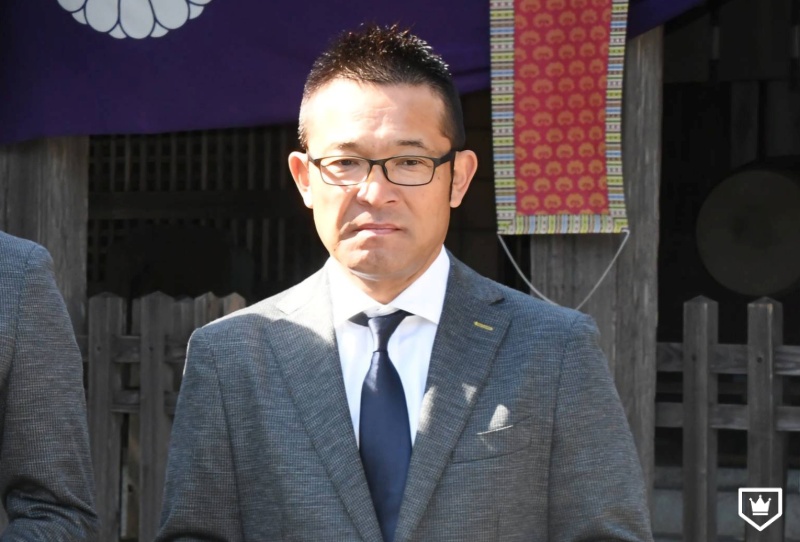
Toshio Haru, the Orix Buffaloes first-team head coach who left the team following the expiration of his contract this season, shared his parting thoughts on the Orix Buffaloes, where he was involved in coaching for four years.
"Our world is that kind of world. It is a world of competition, after all. Normally, one doesn't get the chance to serve as a minor league manager or a first-team head coach. Just being allowed to do that was a learning experience, and on top of that, it was in the Pacific League, which I had never experienced before. I have nothing but gratitude for this organization." A few days after leaving the team, Haru, who visited the club facilities in Maishima, Osaka to clear out his locker, reflected on his four years starting as the chief development coach and expressed his feelings of gratitude toward the team.
Haru is a native of Kyoto City. He joined Yokohama as a second-round draft pick in 1993 from Otani High School and Kumagai Gumi. In a team primarily composed of mid-range hitters known as the 'Machine Gun Lineup,' he formed a 'number one and two' duo with Takuro Ishii, contributing to the league championship and Japan Series title in 1998. After retiring as a player, he served as a hitting coach for Yokohama, DeNA, and Chunichi. He became the development chief coach for the Orix Buffaloes in 2023, served as the minor league manager starting in 2025, and supported manager Mamoru Kishida as the first-team head coach this season. He is leaving the team after just one year, having failed to fulfill his pledge to 'make Mamoru Kishida a success.' He took full responsibility for the team finishing in the bottom half of the standings for the first time in two years, stating, 'I did what I thought the manager wanted, but I feel sorry that it did not lead to victories.'
During his time as a Chunichi batting coach, footage of him encouraging the fielders in a Kansai dialect in front of the bench during games circulated on social media, leading many baseball fans to perceive him as a scary instructor, but young players unanimously describe it as 'strictness rooted in affection.' Although his tone was harsh, he made an effort to offer advice on players' technical issues and concerns while considering their personalities. To Yuma Mune, who was adjusting in the minors due to a batting slump, he shouted during intensive defense training, 'You still want to continue your career, don't you!' Mune, who said, 'It reminded me of the days I aimed to become a regular at Maishima. It made me feel like working hard alongside the younger players,' faced his challenges and returned to the first team. For players who struggled to show their motivation outwardly, he proactively spoke to them to provide encouragement.
During practice sessions when he was the minor league manager, the area near the center fielder's position was Haru's 'regular spot.' Standing for over two hours, he took a bird's-eye view of the entire scene, observing not only the players' conditions but also the movements of the coaches and the training methods of the strength and conditioning coaches. He provided feedback on what he noticed, stating that 'instructing the (young) coaches is also part of the job.'
This season, Haru-san was 'quiet' on the surface. He devoted himself to a supporting role, stating, 'My focus is on how to advance the baseball that Manager Kishida wants to play. In the first team, results are everything. The most important thing is to ensure the players can perform to their full potential. As a bridge between the manager and the players, I just want to make sure things run smoothly.' The only time he became a topic in the media was around the May 2nd game against Nippon-Ham at ES CON FIELD. During the pre-game huddle in the dugout, he shouted, 'Win by out-hitting them!' The team came back from a five-run deficit to win 10-9, and Manager Kishida expressed his gratitude, saying, 'The head coach's shout was great.'
During practice, he stood near second base and communicated with the players as they ran the bases, offering advice on things he noticed. Additionally, he held a private meeting with Manager Kishida before practice to formulate team policies based on the manager's intentions.
The game Rakuten Eagles Rakuten on August 3rd was held at Tokyo Dome for the first time in 17 years. In the first inning, the team gave up four runs due to defense errors, and in the bottom of the inning, the players formed a huddle in front of the dugout, with wall coach Katsumi Yamazaki and others giving instructions to the players. This "emergency meeting" was proposed by Haru at the coaches' meeting the day before. "I thought it would be better to say what we noticed right away rather than saying it later. The manager also thought so." With each game becoming crucial as they head towards the Climax Series, the aim was to tighten up the team once again.
He had never been a member of the Orix Buffaloes before and joined the team upon request. He has said harsh things and things that players might find difficult to hear. While there may have been challenges as an outsider, Haru said, 'It is my job. Because it is my job, I can say things I do not want to say and bring up troublesome matters. Since it is my job, I do not think anything of it. More than that, I have no desire other than to make this team stronger and to help even one more player succeed and earn money. Even if they think I am annoying, it is fine as long as one or two of them take notice.' After achieving three consecutive championships, Manager Satoshi Nakajima, whose team finished in fifth place, resigned while pointing out a sense of complacency and carelessness that had drifted into the team, stating, 'The element of becoming too accustomed to success emerged more strongly this year.' Haru felt a deep sense of responsibility for the results, saying, 'I was called upon by Manager Kishida and was strict in those areas, but I might not have been able to change things much. I did things my own way based on what the manager was thinking, but I was unable to translate that into victories.'
This season, the Orix Buffaloes were unable to assemble a satisfactory lineup due to a series of major injuries to their core pitchers and fielders. Regarding the high number of injuries, Haru said, 'I believe there is a reason why so many injuries are occurring, and unless we properly investigate and improve upon that, I think the same thing will happen again.' The club is considering new equipment and increasing staff to prevent injuries, and he continued, 'We have reached a point where it will be difficult unless the company truly puts effort into reinforcements and increasing the number of coaches and trainers.'
Furthermore, Haru also touched upon the cause of the injuries. 'If you don't practice, it's no good. First and foremost, it's the amount of practice. Practice doesn't lie. While there is scientific analysis now, and it's not about swinging a bat a thousand or two thousand times like in the old days, you won't build the physical strength to last a full year unless you put in the repetitions the right way under a specialized coach. I think that's what we're seeing now. The team's strength is in a transition period and has hit rock bottom, so I think it will take time, but the question is how we move up from here.' While there is no single answer, he emphasized the need to strengthen the medical aspect.
56 years old. 'I don't know what will happen from here, but if I can be involved in baseball somewhere, I intend to continue being myself. I will keep going as Toshio Haru.' His wealth of experience and achievements cultivated as both a player and a coach, along with his passionate feelings toward baseball, are still very much needed in the world of baseball.
Reporting and Text = Masaki Kitano
![[Coach Tsuyoshi Nishioka Steps Down] Today's Pacific League [October 11]](https://media.insight.pacificleague.com/webp/bBUU77DWo19WJw2QDDi40AGxH2YkQ3WiKFfb3FPS.webp)
![[Miyazaki PL] Orix Buffaloes' Seiichi Teramoto hit a lead-off home run off Masahiro Tanaka, but the pitcher lineup collapsed and they suffered a lose.](https://media.insight.pacificleague.com/webp/ChxSfUGicpbk57RdXPJqSjM5q54xHFlTwxBvmq3s.webp)
![Ryoya Kurihara won two batting titles: 2026 Pacific League Title Winners [Batting Category]](https://media.insight.pacificleague.com/webp/RXiiCj0UjQrdMefevwrfWduFLVdZlJLIQqiAy0oe.webp)