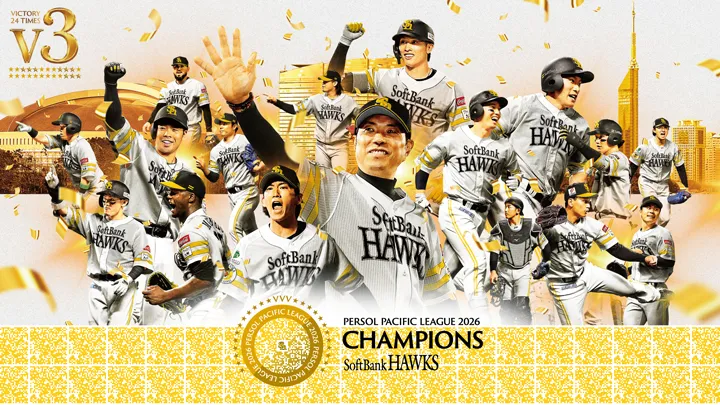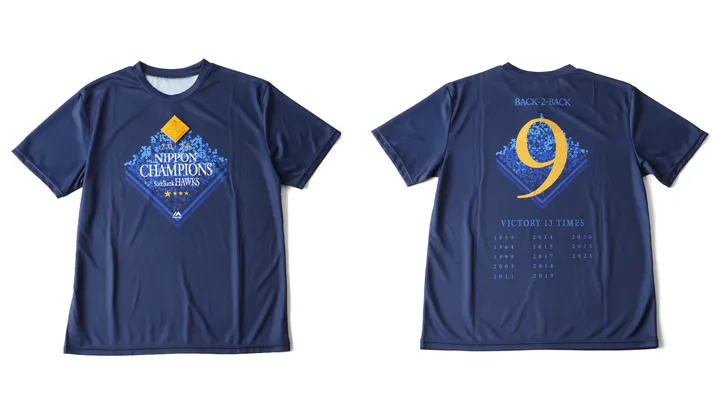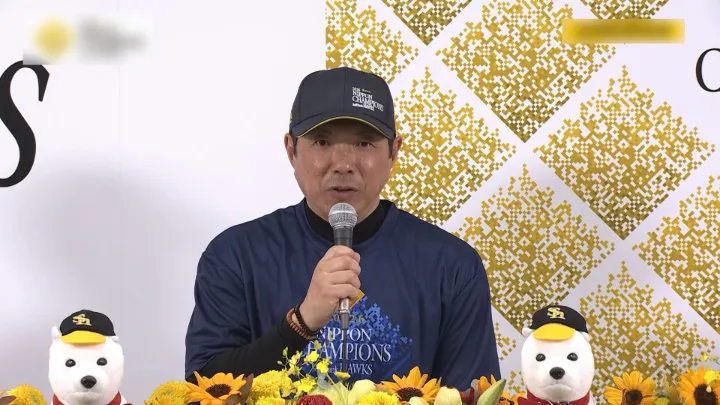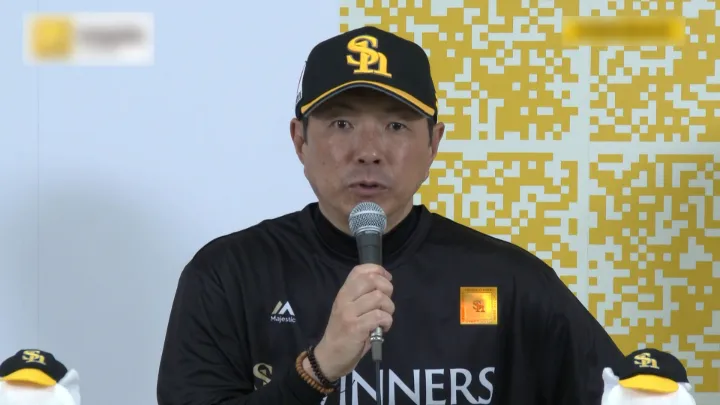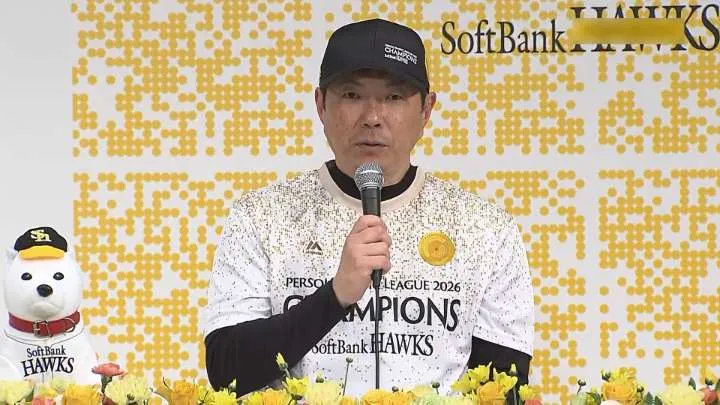
On September 17, Fukuoka Softbank clinched the 2026 Persol Pacific League championship, achieving their first three consecutive titles in 60 years. A press conference was held after the game, attended by manager Hiroki Kokubo, player representative Ryoya Kurihara, pitcher Ryosuke Otsu, and player Tomoya Masaki. The Q&A session with manager Kokubo is as follows.
Manager Kokubo summarizes the season after winning the championship in Osaka for the first time in two years, stating, "I have a strong connection to the Kansai region."
--Achieving three consecutive championships. Your honest thoughts?
"To be honest, I didn't expect it to be decided here in Osaka. I think most of you didn't either, so I'm sure the preparations were a bit frantic. We came in on a nine-game winning streak, but as long as the second-place team didn't lose, there was no championship. I really feel like we have a strong connection with the Kansai region."
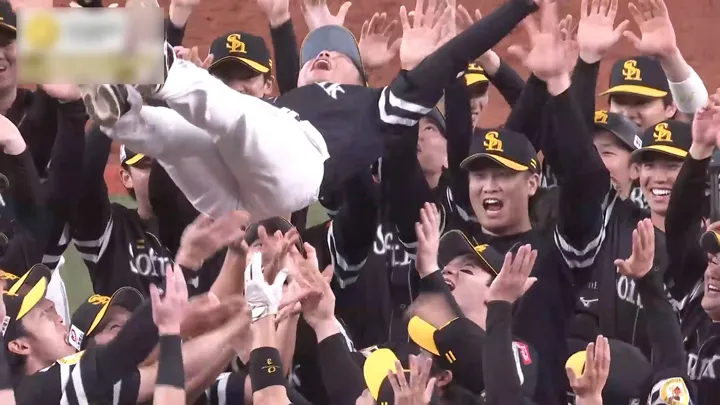
--The victory toss at Kyocera Dome Osaka for the first time in two years. What was your state of mind while being tossed?
"I was thinking, 'This is a victory toss at a visitor's stadium,' while everyone tossed me. From the moment the magic number appeared, the path to reducing it to zero was a very tough one. The eight games at the start of September—I thought that would be the key point, and we managed to navigate through it well, so to speak. Being able to win more games than we lost was the factor that allowed us to ride this momentum."
--This is the first three-consecutive championship since The Hawks moved their home base to Fukuoka. It's been 60 years, adding another new feat to the history of The Hawks.
"We started from camp knowing that we were the only ones who could take on that challenge. I feel extremely honored to be able to carve a new page into this long history of The Hawks."
--The runaway victory the year before last, and the V-shaped recovery from Golden Week last year. Compared to this year, the flavor seems different, but how does this year's championship taste?
"Each one has various memories. As I said in this year's victory interview, it was the series against Hokkaido Nippon-Ham before the interleague games. I think that was quite a key point.
It felt like the momentum shifted to The Hawks all at once at that time. Until then, it was a cycle of winning and losing. From then on, we were able to accumulate a surplus at a pace of two wins and one loss. I felt like I was fighting with the invisible support of Sadaharu Oh's LEGACY DAY."
--The momentum after the tide turned hardly faltered. With what kind of feeling were you leading the team?
"If we won the first game, we aimed to win the series, and if we won the series, we aimed for a three-game sweep if possible—we fought series by series repeating that. It had been about 17 series since the interleague games against Yakult that we finally lost a series. Since we were able to climb all the way to the top spot there, I think the players' hard work was truly excellent."
--At the midpoint of the season, you said the first two months were actually tougher than last year. Looking back now?
"After all, there were almost no injuries among the fielders. The lineup was in good condition. However, there were quite a few games where the starting pitchers couldn't set the pace of the game. We weren't really able to fight as a stable team. But from around the start of the interleague games, the starting pitching staff gradually stabilized.
Yugo Maeda and (Taiga) Kamichatani were in as relievers, but they moved to the starting rotation midway through. Ryosuke Otsu, who is here, also stood on his own and won double-digit games. Haru Matsumoto today also got his 11th win. The emergence of players who weren't there last year is what led us to the championship, or rather, was the factor for the victory, I think."
--Games against The Fighters, the rivals you competed fiercely with until the end of last season. You won three straight at the opening and dominated until the end. What was the factor?
"I think the players feel the same way, but although the results showed a wide gap, in terms of content, it could have gone either way, and I really felt their strength while playing. Although there was this much of a difference when it ended, looking back at each game, I think there were fewer easy battles."
The relief pitchers are highly rated. Regarding Yudai Yamamoto, who was acquired in May, it was also noted that 'it turned out to be a good trade.'
-- There was a period where the starting rotation couldn't take shape. Amidst that, what were the factors that led to winning the championship?
"I felt that the players who were given chances steadily grew as they produced solid results to earn their next week's start. A big difference from last year is that while we usually set the rotation about three weeks in advance, this year specifically, even after summer passed, we operated on a rotation decided one week at a time.
Even so, I think one factor was that our relievers were in perfect form; if we could connect to the 7th inning with Osuna, then to Yuki Matsumoto and Kazuki Sugiyama, we could somehow manage to win it all."
-- Do you have a very high evaluation of the relief squad this season?
"Yes. Yuki Tsumori has been looking a bit worn out lately, but he was throwing very Tsumori-like balls for a while. Also, Gota Suzuki has shown a calmness you wouldn't expect from a rookie, with very stable pitching. At first, we used him for long relief, but now he's producing results to the point where he's breaking into a role in our winning patterns."
-- In May, you acquired Yudai Yamamoto from The BayStars. That had a big positive impact on the pitcher staff.
"Yudai Yamamoto was a player we had been watching closely for several years, so I received a report that things worked out well with Yokohama. I think it truly turned out to be a good trade for both teams."
-- Were there pitchers who were brought out to their full potential by Yamamoto?
"Takashi Umino also performed well when Yamamoto was sidelined with a fracture, and rather than just Umino alone, there's no doubt that adding a catcher who can hit like Yamamoto added even more depth."
Number 1 Tomoya Masaki, Number 4 Ryoya Kurihara... "We were able to put together a lineup with a core."
-- On offense, Ryoya Kurihara and Kensuke Kondo led the lineup as if the two within the team were competing for batting titles
"Having rivals within the team truly creates a synergistic effect. At one point when Kondo was producing home runs in large numbers, Kurihara asked to let him hit before Kondo, but it seems Coach Hasegawa rejected that. He was told to do his job properly behind him.
After all, as he got used to it, he was able to hit back-to-back home runs or leave solid results even after Kondo, and I felt this was also a form of growth. The season isn't over yet, so I want them to keep building up their numbers."
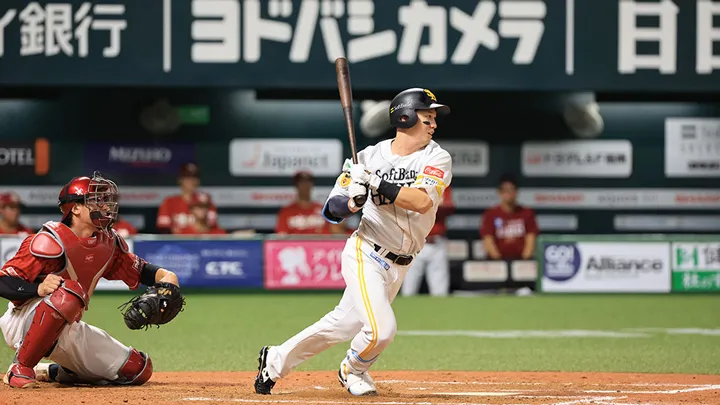
-- Tomoya Masaki returned to the first team in May and became the leadoff hitter from the second game. His settling into that role was also a major factor
"At that time, there was a proposal from Coach Hasegawa, but the fielder coaches and other coaches were also in unanimous agreement, partly because left-handers were going to continue from the next day, that Masaki would be good.
On the day he was promoted to the first team, he dropped a fly ball to right field on the very first play, so he probably couldn't even think about hitting. I think the result of him desperately clinging on has led to these current results."
-- He also set a record for leadoff home runs as the number one hitter. Fans also enjoyed it in the sense that a new style of leadoff hitter was formed
"The fans likely felt that way, and from the perspective of the opposing team's battery, having a hitter at number one who can hit a home run if you make a mistake is definitely a threat. Regarding this year, being able to form an order with a core that didn't move, such as (Masaki) at number one and Kurihara at number four from midway through, was one factor in winning through."
-- You were able to form the order from the 1st to the 5th hitter almost without change
"Ukyo Shuto had an injury at the end, but until then, the top five were almost fixed. Yuki Yanagita had small injuries midway through, but at 38, as the oldest, he reached the regulation number of plate appearances for the first time in a while over the course of the year. I think he became a goal for young players like Kurihara and Masaki, making them wonder if they could produce that kind of performance when they reach that age."
-- In terms of defense and base running, there were many scenes that proved The Hawks are a team one or two levels above the rest, overwhelming others
"Regarding base running, I feel it is both a tradition and a weapon of The Hawks. It is one of The Hawks' weapons that the mid-career and veteran players take the lead and never neglect base running that aims for the next base. I am grateful that they did that in every situation throughout the year."
Regarding this season's third consecutive championship, 'none of the bad predictions came true at all.'
--Looking back on the entire season, it was a three-peat achieved through the convergence of various elements. As the manager, how would you summarize this championship?
"I always think about game management and the annual plan while assuming the worst-case scenarios, but this was a season where my negative predictions didn't come true at all. The players did a solid job, and I believe the combined strength of everyone—the excellent coaching staff and the staff members who supported the players so they could compete at a high level of performance—led us to this victory."
--With the new rules for the PERSOL CS Pa, there is already an 11-game gap with 2nd place. What kind of performance do you want to show in the remaining 11 games?
"(The new CS rules) are the biggest difference from last year. (Originally) having individual players improve their condition was the number one priority in the standings, but we have to set aside the 10-game lead over 2nd place. Next will be prioritizing physical condition for the Climax Series, followed by consideration for individual titles. There are 11 games left, and while we used to give opportunities to young players until last year, I would like to discuss our approach with the coaching staff from here on."