![Tohoku Rakuten Golden Eagles pitcher Kenta Maeda [Photo: Provided by the team]](https://media.insight.pacificleague.com/webp/hIvHelPsmVnYlKSDnD03bqEzNhjh4SRyo26Mmu8z.webp)
From June onwards, it will regain its original stability.
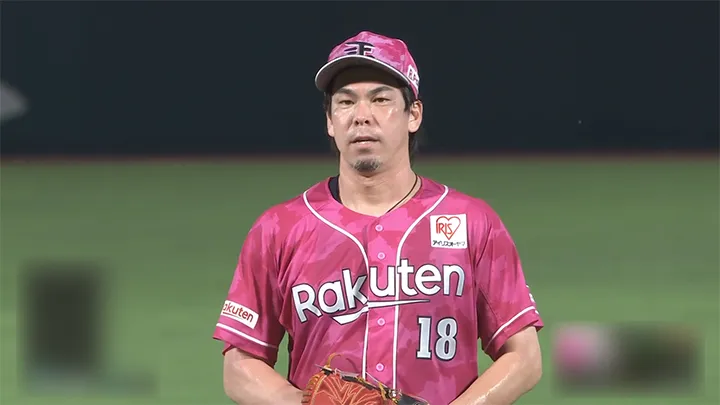
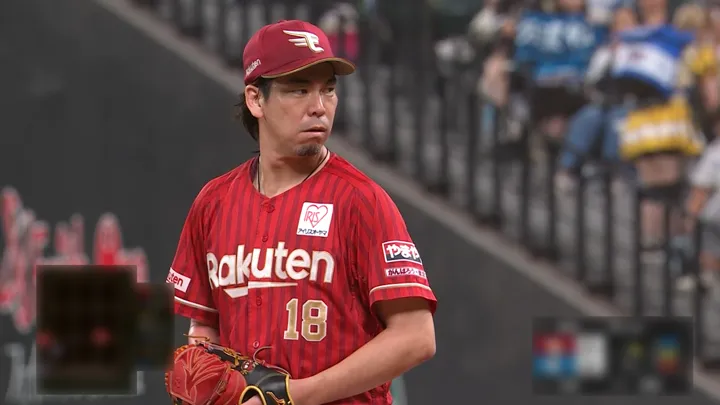
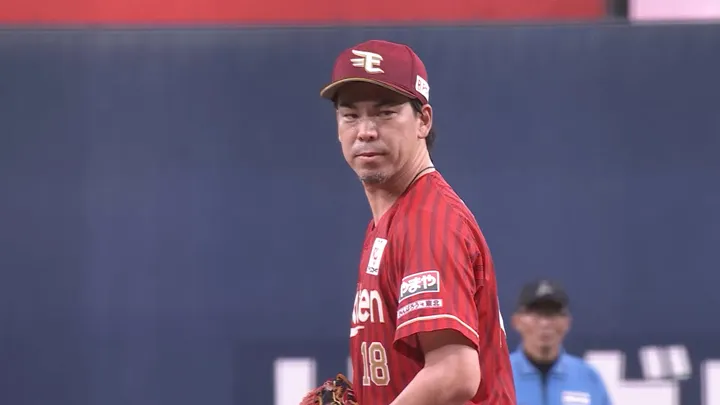
Kenta Maeda pitcher is playing for Tohoku Rakuten Golden Eagles this season, started his professional career with Hiroshima Toyo Carp Carp, where he steadily improved his performance and became the Carp's ace. From 2016, he moved to Major League Baseball, where he accumulated 68 wins in 226 appearances over 10 years.
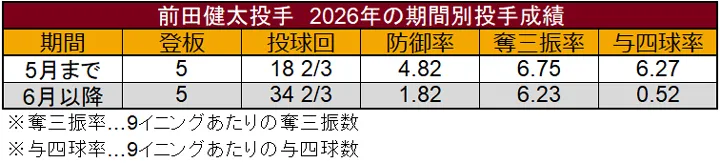
Even for pitcher like Maeda, it took time to adapt to the NPB stage after a long absence. His control, which should have been his strong point, was lacking, and for the first two months from the start of the season until May, he struggled with a 4.00 ERA.
Nevertheless, the veteran, now in his 20th professional season, used his time in the minor leagues to gradually adjust pitch. Since June, he has pitched a total of 34 2/3 Walk, giving up only two walks. He has regained his original stable ERA pitch, posting an excellent ERA of 1.82. So, how did pitcher Maeda manage to rebuild his pitching? Let's explore some of the reasons by looking at the changes in the data.
Changed the strategy before the final push.
fastball During his Major League career, Maeda pitcher built his pitching repertoire around two primary pitches—closer and slider—as well as splitter, while also incorporating pitch. Having returned to the NPB this season, he started the season with the same pitching style.
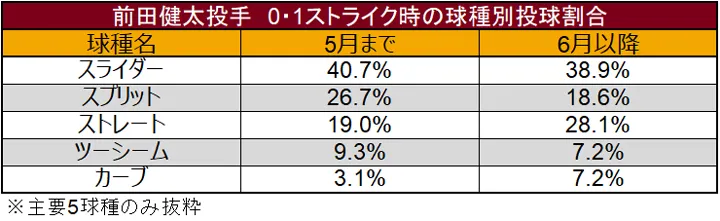
As shown in the table, the percentage of pitches by type pitch for the 0 and 1 strike pitches, these two pitches—slider and splitter—accounted for nearly 70 percent of the total through May. The team relied on these two pitches as the cornerstone pitch of their strategy to secure strike count.
However, it is clear that since June—when his performance improved—he has reduced the percentage of splitter pitches and, instead, increased the percentage of fastball curveballs. Broadly speaking, this suggests that his pitching strategy has shifted from his Major League approach to one more similar to the style he employed during his time with the Carp.
splitter is a cause for concern until May.
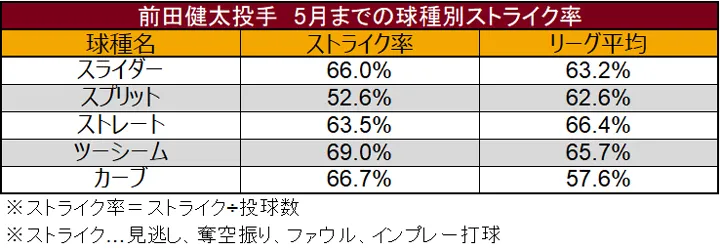
Looking at the strike rates by pitch type, you can see why he changed his pitch arrangement before driving hitter closer. Originally, pitcher Maeda could control all his pitches at a high level, but in the first two months after returning to NPB, his splitter strike rate was only 52.6%, well below the league average, and he did not function as a pitch that earned strike with shallow count.
Therefore, by replacing splitter with pitches that could reliably strike the that was unreliable, it is believed that the pitch was stabilized.
Use your incredibly accurate slider to get out of unfavorable count.
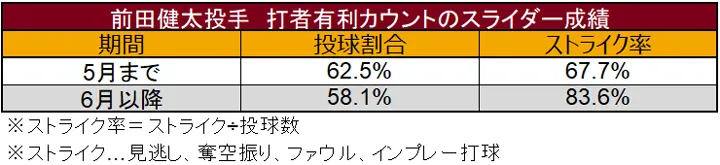
Another notable difference between May and after June is the accuracy of slider. As shown in the table above, in hitter favored count where the ball is leading, the pitch percentage of slider is particularly high, about 60%.
pitcher is the best pitch to choose when overcoming disadvantageous situations, and since June, the strike rate of slider in this situation has risen to 83.6%. Even if the ball takes the lead while competing with hitter, the slider with absolute confidence can quickly set up the count.
Get hitter in a quick count and finish the game before it becomes a 3-ball count.

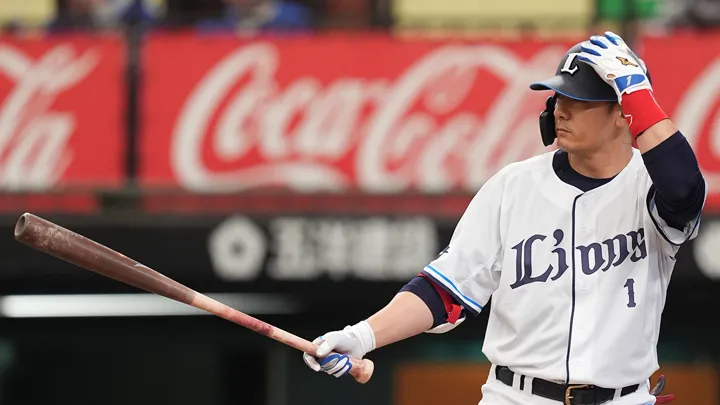
strike Since June, when he began racking up “count” with his high-rate pitches and—even if he started with a ball—was able to set up “count” with his precise “slider,” the number of pitches required to force a “hitter” has decreased. His 2.82 figure is on par with players like Saitama’s Seibu Lions, Chihiro Sumida, pitcher, as well as Hokkaido Nippon-Ham and Takayuki Kato, placing him among the league’s top performers in terms of fewest pitches per .
In addition, the number of at-bats where count reached three balls has decreased significantly, and pitch has shown improved consistency. It’s safe to say that Maeda pitcher, who has closer numerous hitter with his exceptional control, has returned to his usual form.
The accuracy of splitter has also improved significantly.

On the other hand, although splitter was cited as a cause of his poor form until May, it was not completely sealed. Even after reducing his pitch rate at 0.1 strike in June, the percentage after pushing the ball remained unchanged, and perhaps because his role of throwing low to induce swings and misses became clearer, his swing rate in the ball zone and missed strike rate improved.
He serves as a reliable pitch to get struck out. If he becomes less concerned about his splitter accuracy as he pitches more often, he may be able to use him again as a count pitch. If that happens, the range of his pitch will expand even further.
On August 12, in the game against Orix Buffaloes, Maed pitcher a delivered an impressive pitching of 7 innings and 2 runs, becoming the 145th player in history to reach 100 career NPB wins. The reliable new addition to Tohoku Rakuten Eagles, which has been struggling for several years, will continue to build win beyond this milestone record, for himself and to bring the championship flag back to Mori no Miyako.
*All figures in the text and tables are as of August 19, 2026.
Bun Data Stadium
![[Artist Maeken Original T-shirt] Today's Pacific League [August 25]](https://media.insight.pacificleague.com/webp/8jFjYA6aWPlOIQOk6RkTEgNn9uBSjd22xu6Qk6Qs.webp)