I did work hard, but there were also things I could have done better, so it was a season that made me want to try even harder again next year.
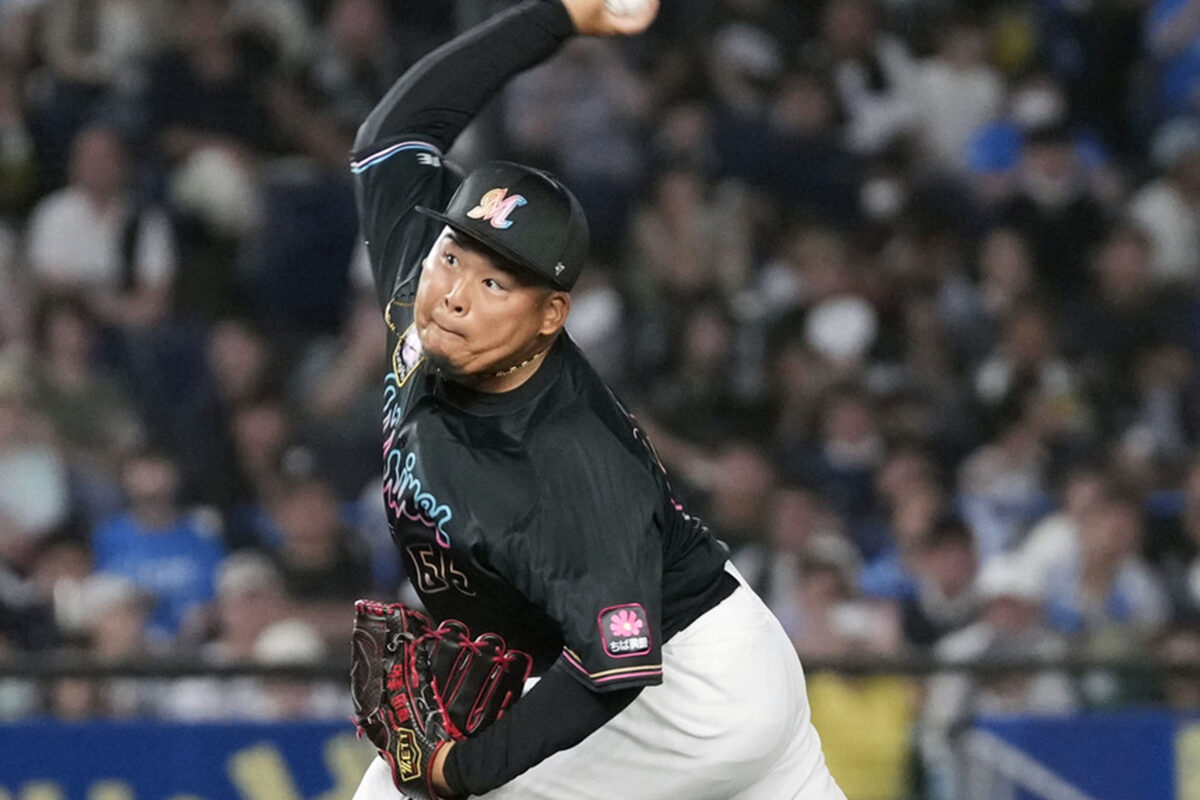
Although Lotte's Keisuke Sawada was removed from the first-team roster on October 1st at the very end of the season, he spent almost the entire time since the season opener with the first team and appeared in 42 games, the most since his transfer.
This season, after changing his number to 54, he has been working since last autumn to master a 'fast, dropping fork.' During an interview on January 26, he expressed confidence, saying, 'I have a good mental image of it now. Since games are about to start, I want to test it out soon and see how it goes. I believe the batter's reaction is everything, so I plan to proceed while anticipating various scenarios,' and with that, he headed into spring camp.
In practice games, especially in local ballparks, the pitch speed may not be displayed on the video. He mentioned wanting to throw fork at around 140 km/h; is he actually throwing it at around that speed?
"It's not really coming out, is it? Since my fastball is a bit slow right now, the other pitches are being dragged down and are slow too," he said, as he had been unable to reach a satisfactory speed since the start of live games.
In the game against the Orix Buffaloes on March 10th, in the 8th inning with one out and no runner on, the third pitch (a 137 km/h fork) and the fourth pitch (a 138 km/h fork) thrown to Ryo Ota after two strikes were balls, but he threw forks that approached 140 km/h. 'I changed it to a splitter. I made the grip shallower,' he said, and the balls thrown as the third and fourth pitches to Ota were indeed splitters with a shallower grip.
In the Seibu Lions game on March 13th, with one out and a runner on first in the 7th inning trailing 1-2, he threw a 135 km/h splitter on the second pitch to Kazunari Ishii after one strike to get a swinging strike and put him in a hole, then struck out Ishii swinging with the next pitch, a 134 km/h splitter. He himself praised the splitter thrown to Ishii, saying, 'It was wonderful.'
He explained the reason for changing from a fork to a splitter by saying, "It's the ball speed." Indeed, since the off-season, he has been practicing hard aiming for a fast, dropping fork. "Because it becomes a pitch type similar to a change-up, it has to be fast to distinguish it as a dropping ball that is different from a change-up. If it's a slow breaking ball, it gets grouped together with the change-up. The idea is to increase the speed while creating movement."
Having practiced fork since last fall, switching to splitter right before the season starts seems like a daring move.
I was practicing my splitter a lot in the autumn. I had Johnny-san (pitcher coach Tomohiro Kuroki) look at my splitter, and I thought I had completed it once, but when looking at the Trackman data from pitching in the bullpen, the splitter I threw in the Seibu Lions game on March 13th didn't show as dropping.
bullpen In February, I asked Mima-san (the second team pitcher coach) to teach me how to throw a fork pitch, which is a little deeper, because he is good at fork pitching. When you think about it versus the hitter, it's the stage of opening the season, so you shouldn't throw the kind of pitches that can cause big injuries (to hitters). I am a reliever. When that happened, I chose breaking ball to be fast splitter because I didn't want to have to fall off against Seibu Lions on the 13th. It's not that I haven't practiced. I practiced both splitter and fork in the fall as well."
He had been practicing since last fall to be able to throw either fork or splitter. "I don't want to give up big extra-base hits, so I chose the option that minimizes that risk," he said, explaining why he switched from fork to splitter at this time.
His fastball velocity had not been as high as he hoped since the start of live games, but during the exhibition game at Vantelin Dome, he threw pitches exceeding 150 km/h, reaching a maximum of 153 km/h that day. 'I feel like my fastball can still get better, so from here on out in the finishing stages, I think it will improve one or two steps further,' he said. Having pitched 9 innings across 9 games in practice and exhibition matches with a 0.00 ERA, he secured his spot on the opening day roster.
Stable pitch since the start of the season
After the season opened, he pitched in the 9th inning of the Softbank Hawks game on April 3rd while trailing 0-2, throwing 15 pitches in one inning to retire the side in order as a closer, which led to a walk-off victory in the bottom of the inning. On April 7th against the Orix Buffaloes, he pitched in the 7th inning of a 1-1 tie for the first time this season, and on April 12th against the Seibu Lions, he went to the mound in the 8th inning of a 0-0 tie for the first time this season. On April 16th against Nippon-Ham, he pitched in the 8th inning while leading 5-3, marking his first appearance in the 8th inning of a winning game this season, showing an increase in his appearances during tied and winning games. 'I just focus on the single pitch in front of me,' he said, indicating that even in tied or winning games, he kept his focus on himself and concentrated solely on his own pitch.
He has been throwing a splitter with a shallower grip since early March, but the fourth pitch splitter that struck out Chusei Mannami swinging on a 1-ball 2-strike count with two outs and a runner on first in the eighth inning of the Nippon-Ham game on April 16th, with the score at 5-3, was a sinker-type.
That was probably due to the wind hitting it and causing it to drift sideways, but since the splitter I threw to Makihara at the PayPay Dome quite a while ago also had a lateral break, I feel like it's becoming more like a sinker aimed at the zone.
Regarding the fact that it drops like a sinker, he revealed, "As long as it moves and I can get a swing and a miss, I'm fine with it dropping or tailing away."
His fastball, which regained its speed just before the season opener, showed its power on April 19th against the Rakuten Eagles. In the 8th inning with one out and a runner on first, and the score at 8-5, he struck out Yukiya Ito swinging with a 148 km/h fastball on the sixth pitch after a 3-ball, 2-strike count. On May 8th against the Softbank Hawks, with a 5-3 lead in the 7th inning and a runner on first with no outs, he recorded a swing and miss from Kenta Imamiya on a 151 km/h fastball on the second pitch after 1 strike, and then struck him out swinging on the third pitch with an inside 151 km/h fastball.
Regarding the fastball that struck out Imamiya, he said it was 'so-so,' but as for the speed of the fastball, he stated in an interview on May 12th, 'It has increased since around the time of the season opener, so I feel like I can still get more speed now. I feel like it is reasonably good.'
In early May, pitches that pushed through with the fastball were prominent. During an interview on May 12th, when asked if the reason for pushing with the fastball was due to having confidence in it, the response was a reliable, "Yes, I have confidence in my fastball."
During this period, he continued to perform as a closer while keeping his signature change-up under wraps, stating, 'I haven't used it yet. I've been pushing with my fastball, and since they haven't perfectly timed it, I thought it would be better to throw moving pitches like the slider or splitter rather than the change-up. My plan is that once they start timing the fastball perfectly, I'll begin competing using the depth of the change-up.'
In the game against Hiroshima on May 28, Akira Yagi took the mound in the 7th inning with a 4-2 lead but gave up a timely hit to Minoru Omori, leaving the bases loaded with one out when Sawada was called to the mound. He got Ryosuke Kikuchi to fly out to right on a 146 km/h fastball, then induced Shogo Sakakura into a groundout to first on the first pitch, a 130 km/h splitter. He escaped the bases loaded jam in just two pitches.
Regarding the splitter that got Sakakura out, he revealed during pre-game practice for the Hanshin Tigers game on May 30th that it was 'statistically the best splitter of the year.'
In the game against the Hanshin Tigers on May 31st, he pitched the 6th inning with the score tied 2-2 and allowed no runs. In the game against Chunichi on June 9th, he pitched the 7th inning with a 3-1 lead and allowed no runs. In the game against Chunichi on June 11th, he pitched the 10th inning with the score tied 2-2 and acted as a closer to allow no runs. During the week of Tuesday, June 2nd, he pitched four times in one week, showing he was pitching extensively in early June.
In the game against the Rakuten Eagles on June 19th, he said, 'If I throw breaking balls to batters who aren't timing my fastball, they often hit them well, so I feel like I should challenge them with the fastball first,' and he completed one inning with zero runs using only fastballs for all six pitches.
As of the end of June, he had appeared in 26 games, boasting outstanding stability with 2 wins, 1 loss, 11 holds, and an ERA of 1.78. Entering July, he gave up 4 runs in the Nippon-Ham game on the 8th and 3 runs in the Orix Buffaloes game on the 12th, but then recorded 6 consecutive scoreless games from the Seibu Lions game on the 15th to the Softbank Hawks game on August 12th.
In the game against the Seibu Lions on July 15, with the bases loaded and no outs in the 7th inning while leading 3-2, he struck out Shuta Tonosaki looking on a fastball with a 3-2 count, reflecting, 'It was a pitch I executed fully, so I think it was a good ball.' He also mentioned, 'I think it was okay,' regarding the July 2nd game against Nippon-Ham, where he retired the lead-off hitter Daigo Kamikawahata on a 149 km/h inside fastball for a pitcher's groundout with a 2-2 count in the 8th inning while trailing 0-3. Additionally, his inside fastballs against left-handed hitters were effective, such as the 151 km/h inside fastball used to get Tatsuki Mizuno to swing and miss for a strikeout with a 1-2 count and no runners on with two outs in the 8th inning of that same 0-3 game.
Regarding the splitter, he said, 'I prioritize throwing it so it doesn't float and lead to an extra-base hit, so I feel it's quite good when they swing even at a bounce.' The 130 km/h splitter he used to get Canario to swing and struck out on a 2-ball, 2-strike count with two outs and a runner on second in the 7th inning of the July 15th game against the Seibu Lions, while trailing 3-5, was magnificent.
Regarding his specialty change-up, he said, 'I don't think the hitter is looking for it, so it has become a pitch that can reliably get a count, and I feel it would be good if I could use it in a sequence that makes it a finishing pitch,' and the number of situations where he throws it has increased since July.
In the July 23 game Rakuten Eagles, where he closer one inning without runs, he threw 11 pitches, 9 of which were breaking ball, and his pitch using breaking ball really highlighted the strength of his fastball. "My pitch distribution was unbalanced, sometimes giving up power hits or home run, so I'm thinking about various things as I play."
In the game against the Softbank Hawks on August 12, with one out and no runners in the 8th inning and the score at 4-10, the slider that got Tomoya Masaki to ground out to second on a 1-ball 1-strike count, and the slider thrown as the first pitch to Ukyo Shuto with two outs and no runners in the 8th inning that resulted in a foul, both had a trajectory like a change-up and a speed in the low 120 km/h range.
He revealed, "I wanted to try incorporating some vertical downward movement. If I only use horizontal movement, there are times when the ball gets picked up, so I'm trying things like that as well."
He had kept the opponent scoreless for six consecutive games as a closer, but he gave up three runs in the Seibu Lions game on August 14th and one run in the Rakuten Eagles game on the 18th, conceding runs in two consecutive games. After pre-game practice for the Nippon-Ham game on August 22nd, he confessed his inner feelings, saying he was 'at the limit' and 'at the most critical point right now.' In the games against the Softbank Hawks on August 26th and 27th, he held them scoreless for one inning each.
Regarding the splitter, the 131 km/h outside splitter on the second pitch that induced a swinging strike from Ryoya Kurihara with a 1-strike count in the 5th inning with one out and no runners during the Softbank Hawks game on August 26 (score 3-5), and the 129 km/h splitter on the third pitch that induced a swinging strike from Yudai Shoji with a 1-ball 1-strike count as the leadoff hitter in the 6th inning during the Softbank Hawks game on August 27 (score 2-4), both showed excellent movement from the strike zone into the ball zone.
"The splitter's velocity isn't quite there yet, but the way it drops is stable. The feel of the throw is good, so I think if the speed comes up, it will become a finishing pitch I can use in any situation. I'm in a process of trial and error regarding how to increase both the drop and the speed; if I lean too much into speed, I can imagine giving up extra-base hits on balls that stay in the strike zone, but if I focus too much on the drop, the speed drops to a point where hitters can lay off it. It feels like I'm wandering right on that edge."
So, that explains why the velocity of the second pitch—a splitter that induced a swinging strike from McCusker with a 1-ball count during the seventh inning with two outs and runners on first and second, while trailing 2-4 in the game against the Rakuten Eagles on August 18th—was 128 km/h, which is slower than usual.
That's right. I didn't want to make a mistake, because if it stays in the strike zone, there's a high probability it will become an extra-base hit, so I was consciously trying to throw it as a ball.
While he had managed to hold the opponent to zero runs for two consecutive games through trial and error, Sawada, the closer, tightened his resolve during an interview after pre-game practice for the Seibu Lions game on September 1st, saying, 'I'm at my limit. I'm on the edge.'
During this period, looking at the pitch form, the movement during the translational motion appeared to have changed slightly.
When confirming with Sawada himself, he revealed, "I am changing it," and explained, "I was throwing with my left shoulder tucked in a bit too much, causing my body to swing. As summer approached, I didn't want to swing my body as much, so I'm aiming not to tuck my left shoulder in too far. Usually, I tuck it in to the limit and use the recoil to snap the ball, but that was becoming excessive and causing my control to be inconsistent, so I'm trying to improve that somehow."
While it may feel like using recoil increases speed, Sawada, as a pitching technician, is making adjustments to the slight areas where velocity does not drop, stating, 'The more recoil you use, the more speed you get, but I am refining it to a level where it doesn't drop from there.'
He is trying out changes in his movement starting from catch. 'I try it in catch, try it in the bullpen, and if the results are good when I throw in a game, I continue with it. If the results are questionable, I make adjustments from there. If I don't change day by day and just keep doing the same thing, the hitter will get used to it and will definitely hit it.' In order to be the closer for the hitter in front of him, he stepped onto the mound, evolving every day through trial and error to move in a better direction.
Regarding September, he said, 'I don't feel like anything has particularly changed. It just looks good, doesn't it?' On the 11th against the Softbank Hawks, he made his 40th appearance of the season for the first time in eight years since 2018 during his time with the Orix Buffaloes. In the game against the Rakuten Eagles on the 17th, he threw a 147 km/h called strike fastball on the outside corner to the leadoff hitter Muneyama in the 9th inning with the score at 1-5 after a 1-ball count. Then, with one out and no runner in the 9th inning at 1-5, he struck out McCusker swinging with a 127 km/h splitter on a 1-ball 2-strike count, which had a great drop from the strike zone into the ball zone.
When asked to confirm if the fastball on the outside corner to the left-handed hitter was breaking, he revealed, 'It was breaking. It usually breaks, so there are times I don't want it to break and times it's fine if it does, so I can't say for sure.' Regarding the splitter that struck out McCusker, he said, 'The speed isn't there. I was being too careful, so the speed was slow. It was around 127 or 128, but even so, right now I don't want to make a mistake with my control, and I don't want to give up an extra-base hit.'
In his final appearance of the season against Nippon-Ham on September 28, he pitched one inning and allowed two runs. This season, he appeared in 42 games, recording 2 wins, 1 loss, 11 holds, and an ERA of 4.14.
Reflecting on the season regarding his fastball, he said, "It felt like there were both good and bad times, and I feel it can still get better, so I will work hard to throw even better pitches next year." Regarding the change-up, which he had sealed off in early spring, he analyzed, "I was able to keep throwing it to left-handed batters toward the end, so I feel like both the fork and the change-up have taken shape."
Regarding the splitter, he had a satisfied look on his face, saying, 'Since it was a pitch I didn't have last year, and I only gave up one home run while throwing it throughout the year, I think I've managed to develop it into a pitch that can be used reasonably well in games.'
Regarding the slider, which he often used as a finishing pitch last season, he noted his challenges, saying, 'I want to use it more consistently. I feel like I didn't use it as a finishing pitch that much, but after throwing the slider for a whole year, I think it worked better on the outside against left-handed hitters. I need to work hard this autumn to figure out what to do with the outside against right-handed hitters again.'
"I want to be able to use my slider and splitter as finishing pitches with confidence. As for my fastball, I will do my best with it." Although he had many difficult pitches from the summer onwards, he wants to show stable pitching throughout the entire season next year.
Interview and text by Yuta Iwashita