Compared to last year, I was able to pitch in more games, and I think being able to pitch two or three innings is a plus for me.
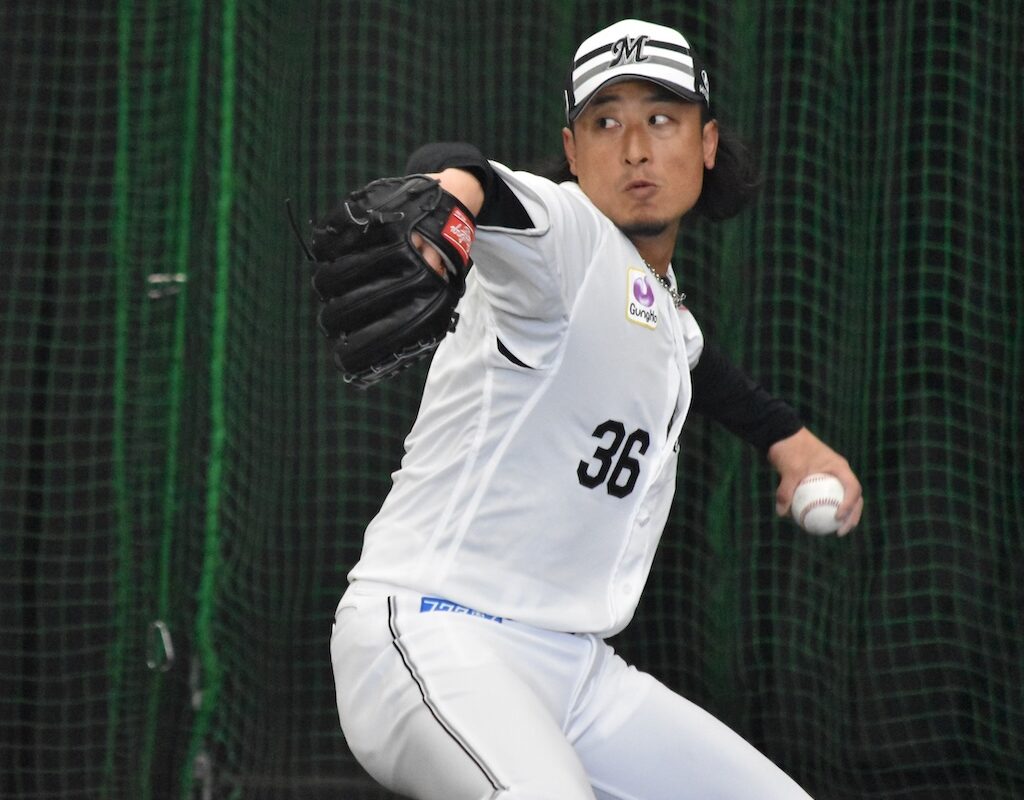
Lotte's Koshiro Sakamoto looked back on this season in this way.
Sakamoto was limited to just 8 appearances last season, his worst since transferring, and he bit his lip as he said, 'To put it simply, it was a frustrating season. I cannot repeat that same frustration in the coming year (2026), and I have to change the things that need to be changed.'
Regarding his independent training for this season, he worked hard on his exercises in pursuit of flexibility, stating, 'I felt very strongly that my body was becoming stiff, in addition to the need for stability, so I focused on making my body more supple. I was working with a focus on physical coordination.'
Regarding his pitch, he said, "During my independent training, the feeling of throwing good fastballs has been increasing. I hope to continue that," as he refined his lifeline fastball. He also expressed his intention to prevent the hitter from narrowing down their targets by throwing the cutter and splitter, stating, "If I only rely on the fastball and slider, they will narrow it down. I think it makes a difference for the hitter just by having the cutter and splitter, so I want to continue working on those."
In the live BP on February 10th, he threw a 113-kilometer change-up on the fifth pitch of the first set to Kota Inoue, catching him looking. The change-up is a pitch type he hadn't thrown much until last season, but he is testing it out, stating, 'I think the more pitch types I have, the better, and since the accuracy feels good in the bullpen, I am throwing it.'
He felt positive about his performance, saying, 'There were some moments where I was pulling the ball, but that last change-up to Inoue is becoming more accurate even in the bullpen. In my case, I have my fastball and slider, so if I can increase the ratio of splitters and change-ups compared to last year and previous seasons, I think the range of my pitches will also expand.'
In the practice game against Hiroshima on February 18, he increased his repertoire for the new season by throwing a change-up and other pitches. After his first appearance in an external game against DeNA on February 14, he had pitched three consecutive games without allowing a run as a closer, but after giving up runs in the game against the Orix Buffaloes on February 25 and the exhibition game against the Rakuten Eagles on March 4, he spent the rest of his time with the farm team.
In the farm team, he continued to work with a focus on the coordination between his upper and lower body, stating, 'Basically, I have been constantly working on that flexibility and coordination.' Regarding his pitch performance, he held opponents to zero runs for four consecutive games from the start of the season as a closer and received his first promotion of the season on April 7th. His first appearance this season came on the same day in a game against the Orix Buffaloes, entering the game in the 8th inning with two outs and a runner on first and second while trailing 1-3. Although he allowed an infield hit to Kenya Wakatsuki, he got Kotaro Kobayashi to fly out to right field on a fastball, putting a zero on the scoreboard before returning to the dugout, saying, 'I think it was a very good start.'
The fastball was powerful, with the second pitch thrown to Kurebayashi after one strike being a swing and a miss clocked at 151 km/h. 'It was my first time hitting 150 this year, but my mind and body were in perfect sync, which resulted in good speed. The quality of the ball is getting much closer to what I am aiming for, so I intend to keep working on this.'
Although there were no matchups against left-handed hitters in that day's appearance, he had been looking forward to facing them, saying, 'The key will be how much I can use the splitter against lefties. I want to face them soon.' In his second appearance of the season on April 14th against Nippon-Ham, in a situation with one out and no runners in the 8th inning while trailing 1-4, he faced left-handed hitters for the first time this season. He retired Haruki Nishikawa on a ground ball to second base with a 150 km/h fastball on the fourth pitch after a 1 ball, 2 strike count, and then struck out the following hitter, Yua Tamiya, swinging with a 142 km/h cutter on the outside corner after a 1 ball, 2 strike count.
During the February spring camp and practice games, he was throwing a change-up, but he remarked, "I am throwing it, but while facing batters, the splitter is dropping nicely and I'm getting swings and misses." He added, "I have to produce results as quickly as possible. Since I felt the splitter was working well for me, I've been minimizing the change-up and switching to the splitter." As of April, the priority of the splitter increased, and the proportion of change-ups naturally decreased.
In the game against Nippon-Ham on April 16th, he pitched in the 7th inning of a 4-3 winning game for the first time this season, holding the opponent to zero runs for one inning. In the game against the Orix Buffaloes on April 21st, he took the mound after starter Jackson in the 6th inning with a runner on second and no outs while leading 4-3, and held them to zero runs for one inning as a closer, but he was removed from the first-team roster the following day on the 22nd.
After being recalled on May 17, he dominated hitter with a strong fastball. On May 24, in the game Rakuten Eagles where he closer two innings without runs, he got Ryuya Taira out on a 3-ball, 2-strike in the third inning with a score of 1-8 and runners on first and second, and got to struck out on the sixth pitch, hitting a 146 km/h fastball on the inside course. On June 10, in the game Chunichi, he got Yuta Ishii, the leadoff scorer 1-11 in the seventh inning, swinging struck out from 1-strike 11 to 1-11, swinging to 148 km/h fastball fastball, and with two outs and runners on first and second (1-11), he got Yuki Okabayashi swinging struck out from 1-strike 11 with two outs and runner, all of which were outstanding.
Regarding the factor behind the significant improvement of his fastball, he explained, "It's not exactly about setting the line, but when things were a bit off, my body would always rotate outward. This year, I've been able to make corrections whenever I feel that's going wrong, so I think that's why I'm able to stay calm on the mound."
In the game against The Giants on June 7, with the score tied 1-2 in the eighth inning with one out and a runner on second, he fastball all pitches up to the sixth pitch against Hayato Sakamoto. On the seventh pitch, thrown from 3-ball, 2-strike, with the opposing hitter focused on fastball, he unexpectedly missed the ball at an outside slider of 131 km/h and retired him struck out. "I tried to keep the count straight as possible, and at the final moment, I thought it would be slider at the end, and I got the autograph from Toshiya Sato, so I feel like I was able to go without hesitation."
In the game The Giants on June 5th, he was aggressively throwing cutter and slider to the inside corner against left-handed hitter, but was he doing so intentionally?
"I've not just started aiming for left-handed batters, but I've always had that image in mind when I pitch. I think that's working well internally now."
He used to throw a sinker to the inside corner against left-handed hitter, but perhaps he's now throwing slider to the inside corner against left-handed hitter because slider is working better than his sinker.
"Yes, there are limits to what you can do just by throwing outside pitches, so I'm also trying to throw inside pitches as well. Just throwing an inside breaking ball makes a difference to the batter, so I'm throwing them intentionally."
In the Chunichi game on June 10, with one out and a runner on third in the sixth inning with a score of 1-11, he swung Seiya Hosokawa on the fourth pitch, a 140 km/h cutter on the inside course, strike 1-11, and in the Nippon-Ham game on June 23, with two outs and a runner on first in the eighth inning, he struck out the Yuya Shindo on a 2-ball, 2-strike and struck out at 128 km/h slider outside the field, demonstrating the power of slider and cutter in the "right-handed hitter."
"Besides my fastball, my main pitches will be slider and cutter, so I think it's great that I'm getting a lot of swings and misses and called strikes with them."
During this period, he wasn't throwing many forks or splitters. I wonder if he's hiding them for the summer season.
I am not the kind of pitcher who can afford to hold back, so when the time comes and I have to throw it, I will. For now, I have been throwing because my cutter and slider have been very effective at getting the count in order. However, as I face a succession of right-handed batters, I think there will be a limit to what I can do with just breaking balls, so when that happens, I feel I will have to start throwing the splitter as well.
Multiple innings
Not only as a short stop inning, he pitched three innings with zero runs as a closer in the Orix Buffaloes game on July 11, and also pitched two innings with zero runs as a closer in the Softbank Hawks game on July 18.
When asked if he resets his mindset before taking the mound for multiple innings, he said, "I try to keep my focus as much as possible." In the game against the Softbank Hawks on July 18, he pitched across the 5th and 6th innings. There was an event after the bottom of the 5th inning, making it a difficult situation to refocus his mind.
Regarding the game against the Softbank Hawks on July 18th, the 5th and 6th innings were my first this year, but I wanted to proceed as usual, so I only changed my undershirt and stayed on the bench doing things the way I always do.
Regarding pitching the second inning, he established a routine, saying, 'Up until about last year, if I was going for another inning, I would start playing catch from around the time there were two outs in our attack. I decided to stop doing that because if I start again too early, I end up throwing too lightly. To eliminate that, I now go to the mound the moment the sides change, throw just one light pitch, and then enter the game by pitching as if it were the first inning.'
He has also been throwing a two seam fastball since the summer.
This season, Sakamoto often showed stable pitch performances only to follow them up with games where he gave up a large number of runs. On June 13th against DeNA, he allowed 3 runs in 1 2/3 innings, but from the June 23rd game against Nippon-Ham to the July 14th game against the Seibu Lions, he had five consecutive scoreless appearances. His ERA after the June 13th game against DeNA was 3.55, but it recovered to 2.33 by the July 14th game against the Seibu Lions. In the August 7th game against the Orix Buffaloes, he pitched 2 innings with 0 earned runs, bringing his ERA to 2.73, but in the following game against SoftBank on August 11th, he gave up 4 runs in 1 inning, causing his ERA to jump to 3.95.
However, the strength of his fastball remained unchanged, which made it all the more regrettable. "There are games where you give up runs, but that happens when the ball catches too much of the plate. I want to be able to induce foul balls in those situations, but I think the quality of the pitches themselves is much better compared to last year or the year before."
He was removed from the first-team roster for the second time this season on August 12 and was promoted again on August 29. After his re-promotion, he began throwing a two seam fastball to left-handed hitters. In 2024, he threw it to the inside corner against left-handed hitters, stating, 'Rather than using them for different purposes, I throw it thinking that just the presence of a two seam fastball will make the slider feel even further away.' Last season, he had said, 'I am practicing the two seam fastball, and although I don't know when it will be, I hope to throw it reliably at the beginning or middle of the season,' but in the end, he hardly threw it during the season.
Regarding the reason for starting to throw the two seam fastball again, he explained, "Since I only had the straight fastball, slider, cutter, and splitter, there were only pitches moving away from left-handed hitters. I wanted to throw a ball that moves inside somehow, and I think that is working out well right now."
Regarding the reason he started throwing the two seam fastball, he told us, "I used to think I had to use strange tricks because it was a two seam fastball, but just by changing the grip and throwing it like a straight ball, the ball started to move quite a bit during catch and pitch practice. I thought this might be good enough, and as I went through various trials and errors, I felt it could be used in games, so I started throwing it again."
Against left-handed hitters, he is throwing not only two seam fastballs but also sliders to both the outside and inside corners. He expressed hope for a synergistic effect, saying, 'Just by having balls that come inside, I think the balls that break away, whether they are sliders or cutters, become more effective for the hitter. I believe that is something we can utilize.'
After being promoted back to the top team on August 29, he appeared in seven games, and the only time he allowed runs was in the game against Nippon-Ham on September 28, where he gave up three runs. This season, he pitched 35 innings across 29 games, finishing with a record of 2 wins, 1 loss, 1 hold, and an ERA of 3.86.
Looking back on this season
Throughout this season, I felt the strength of his fastball. The player himself felt confident after the season ended, saying, 'That is exactly right; while things rarely got bad, I think I was able to consistently throw a strong fastball.'
Since I started throwing the two seam fastball, it seems like my other pitch types have also become more effective. "I was able to jam left-handed batters quite well with the two seam fastball. Within that context, I felt that my slider and cutter really came to life, and I think the breadth of my pitch selection has changed as well."
I wonder if throwing the two seam fastball and slider to the inside against a left-handed hitter made it easier to throw the slider to the outside corner as well.
I think when I am the pitcher, the focus tends to be on the outside, so just by having balls like the slider or the fastball coming into that mix, the batter has to account for them as well. In that regard, I think it became easier to throw the slider at the end.
I wonder if the reason there were few splitters and change-ups was because he was able to be the closer using his cutter and slider.
That's right, the two seam fastball breaks and sinks quite a bit against right-handed batters, so I thought it seemed very usable and wanted to master it. I was working on it with the hope that I could make it my own during actual game situations.
While seeking stability this autumn, he vowed to master the two seam fastball, saying, "The feel of my two seam fastball is very good, so I want to make it my own. If I can master it, I think the range of my pitches will change next season, and I'll be able to pitch more easily. I intend to pursue that."
Regarding off-speed pitches, I wonder if he has any plans to train the change-up he was throwing in early spring throughout the autumn and winter to make it even more effective.
It would be very convenient to have a breaking ball that drops, and it would also be a useful pitch against right-handed batters. Regarding that, I intend to continue working on both the two seam fastball and the dropping ball.
He also changed the position where he steps on the plate to the third-base side. Reflecting on pitching from the third-base side, he said, 'I thought about trying to step here during my independent training, and although I initially thought the slider might slip, I was able to throw it without it slipping. I wondered if it would be easy to hit during exhibition games, but I decided to keep trying it and ended up changing my position on the plate for the rest of the year. I can throw with confidence, and even if it slips, I felt it would stay around the inside corner for left-handed batters. That felt right, so I stuck with it all year.'
Regarding next year and beyond, he plans to continue pitching from the third-base side of the plate, stating, "It makes it easier to throw the two seam fastball to the left from that side, and while I thought I could create a break with the slider, it wasn't there, so I intend to keep working on it."
Sakamoto sets a goal of appearing in more than 50 games every year. For next season, he expressed his strong determination, saying, 'I say this every year, but I want to clear the 50-game mark. This is a world where I have to pitch in winning situations, so I want to be able to do that. Since I haven't earned full trust yet and there were times when people didn't know what to expect until I actually pitched, I want to get myself into such good shape that they can count on me even before I take the mound.'
Interview and text by Yuta Iwashita