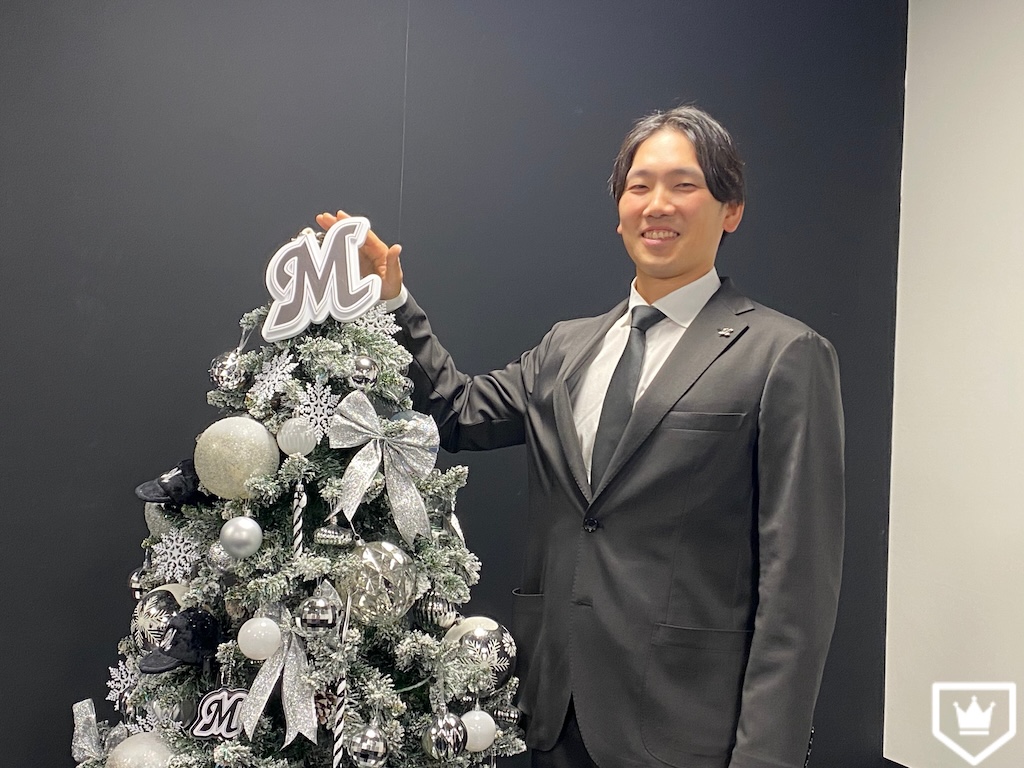
"The content and results were far from what we were looking for. This was my first year, so I was in an unfamiliar environment and playing at home in an outdoor stadium for a year was different. Now that I've experienced it all, I won't be able to make excuses next year. I think we'll be scrutinized even more closely as a team as we try to make a comeback, so I just want to respond with good results."
Lotte's Shuta Ishikawa pitched in 19 games and 103 1/3 innings this season, his first year since the transfer, with a record of 4 wins and 7 losses and ERA of 4.62.
On December 11th of last year, he announced his joining, saying, "I have decided to start the next stage of baseball career with Chiba Lotte Marines." At his joining press conference on December 19th, he stated his determination, saying, "I will do my best to live up to expectations."
This was his first spring training camp in Ishigaki Island since the transfer. "I feel like I'm working in a really comfortable environment, and I think I'm doing what I want to do." On February 2nd, he took to bullpen for the first time since the transfer, throwing 34 pitches against Toshiya Sato. On February 14th, he pitched in his first live BP since the transfer, throwing 20 pitches and closer the number of hit hits to three, and broke the bat of Daito Yamamoto with an inside fastball.
He made his first appearance in a real game on February 26th at the 2025 Spring Miyazaki Baseball Games against Orix Buffaloes, and pitched three innings in an exhibition game against DeNA on March 4th, barely throwing cutter. When asked if his preparations for the opening game were a factor, he said, "The percentage can change during the game, so it's not like I'm trying to throw more cutter is when my other pitches aren't as good, but I just want to throw a variety of balls evenly."
In his final appearance of the exhibition season on March 18th closer Rakuten, he pitched five runs inning and threw a full range of pitches, including fastball, curveballs, cutter, fork, and change-up.
During the exhibition game against Rakuten Eagles on the same day, he said, "It wasn't really my style, so I was actually better at pitching to the inside of right-handed batters, but in the form of the game against Rakuten Eagles on the 18th, I was able to throw accurately to the inside of left-handed batters, so I chose to throw a straight pitch." He threw a high-quality fastball to the inside of left-handed hitter.
On March 25th, he pitched five innings in a game against Rakuten Eagles 's second team, and after pitching 19 inning in five games in total with both the first and second teams, he was ready for regular season.
"I think it's important to always be in a position where I can take a fighting pose without getting injured, and if I get injured I won't be able to show my fighting spirit, so no matter where I am, I want to be able to show that I'm fighting."
Game Orix Buffaloes on April 3rd, which was his first appearance after transferring. It was his first appearance after transferring to his home base, Zozo Marine Stadium, but he said, "I slipped and the ball came out, and as a result, it became a dangerous pitch, and I feel sorry for Wakatsuki," and in the second inning of 0-0, with one out and one out, the first pitch of Kenya Wakatsuki hit the brim of his hat and sent off the dangerous ball. He threw 1/3 innings and gave up mound with 3 hits hit and runs no hits.
In his second appearance since the transfer, on April 11th against his former team, Softbank Hawks, he threw 67 pitches over 5 innings, hit 3 hits, 3 strike out, and 2 runs, resulting in a tie. His curveballs were outstanding, including a 125 km/h curveball on the outside corner that got Yuki Yanagita Akira Kawase to ground out to first base with one runner and no runners on base in the first inning with the score at 0-0, and a 128 km/h curveball on the inside corner as his eighth pitch with two strike and no runner on struck out with the score at 0-0 with no runners on base in the first inning.
"Basically, the curveball is my lifeline, or rather, I think it's my strong point. I think batters don't like balls that have a lot of movement and are slow or fast, so I think that's a good thing, or rather, you have to pitch it with the premise that it's good, and I think it needs to be your number one weapon at all times. It's difficult to pitch a curveball with just a straight pitch, so it's important to vary it up from there, so I think that's a good thing, and it was probably big that I was able to get results with it."
Softbank Hawks In the battle, he said, "I think that there are things that I realize by talking, no matter what the content is. I want to talk as much as possible about these things, or rather, I have to talk about them. I think that's part of my job, so I try to talk about it with that in mind." After inning returned to the bench, he communicated closely with Toshiya Sato and the rest of the catcher team.
In the first inning Seibu Lions on April 22nd, he needed 27 pitches, but he managed to keep the game going with only two runs and one hit in five innings. "At first, I went for my best pitches, or rather, pitches I was confident in, but there were some pitches that I wasn't paying attention to the opposing batter, so I thought I might try throwing more fork. cutter wasn't in good shape, so it was really tough, but I felt like if I could improve that, it would be better." In the first inning, he mainly threw fastball and curveballs, and from the second inning onwards, he threw a variety breaking ball.
In terms of "pitches that opposing hitters are not aware of," with one out in the 0-1 2nd inning without runner Yuto Koga, Koga missed struck out a 132 km fork in-course pitch from 1 ball 2 strike and hitter had a reaction that he did not expect. He recalled, "It was a pitch I wasn't expecting either, so the result was okay, so it was one pitch I reflected on."
Although he only allowed one runs in five innings, in a statement sent by the team's public relations department after his appearance, he said, "Overall, my pitching was poorly paced." Watching the game, I didn't feel that his tempo was that bad, but I wonder what it was that made him feel that his tempo was bad.
"I think there were a lot of unnecessary balls that weren't the ball I was imagining, but I think that's where my tempo was off."
In April, he pitched 11 1/3 innings across three games, posting a 2.38 ERA and 0-0 record. Although he was able to keep the opponents in check, he was not blessed with a win. closer, he commented, "I've had plenty of experience with that, so it's not something that puts me in a negative mindset, so I'm not worried about it at all," and headed into the battle in May.
In May, he pitched 5 2/3 innings against Softbank Hawks on the 3rd, giving up 5 runs, his first loss since the transfer, and then pitched 17 2/3 innings in 3 games, finishing with 0 wins and 2 losses and ERA 5.09.
Regarding the game The Giants held at his home stadium, Zozo Marine Stadium, on June 4th, he said, "I wanted to win as soon as possible, and whether it's at home or away, the sooner the better. In the end, I was able to win at home, and it was refreshing to have the hero interview at home, so I think that was good." He threw 93 pitches over seven innings, closer the runs scoreless, and was pleased with his first win since the transfer.
In the game against DeNA on June 20th, he teamed up with Ryusei Terachi for the first time regular season, closer the DeNA batting line hitless through the fourth inning, allowing only one runs in six innings for his second win. In the game against Softbank Hawks on June 28th, he pitched six scoreless innings for his third win, completing a three-game winning streak in June without runs loss, pitching 23 innings in four games with a 1.96 ERA, demonstrating his solid pitch.
In his first appearance of July, on the 9th against Nippon-Ham, he surprisingly gave up 8 runs in 5 innings and was the lose pitcher. However, on the 21st against Orix Buffaloes, closer the opposing team hit until the 6th inning with two outs and no runner on base, throwing 103 pitches over 7 innings, allowing 1 hit, 6 strike out, 1 BB, and no runs, earning his 4th win. His battery partner was not Ryusei Terachi, but the experienced Tatsuhiro Tamura. After the game, manager Masahito Yoshii explained his intentions for using Tamura, saying, "First of all, Teraji is going to be playing in the All-Star Game, so we wanted to give him a rest. Also, we thought that his combination with Ishikawa and his pitching would be key, so we decided to use the experienced Tamura."
Ishikawa and Tamura, who formed a battery for the first time in regular season after the transfer, had excellent communication and lined up zeros on the scoreboard. In the early part of the game, Ishikawa mainly pitch fastball and curved pitches, but in the 5th inning, 8 out of 9 pitches were breaking ball, so pitch were mainly breaking ball.
Ishikawa expressed his gratitude to Tamura, saying, "Personally, I had said I wanted to throw a straight pitch, but he said, 'Let's go this way,' and I told him to leave it to me and make sure he could throw well. He led me well."
His first appearance after the All-Star break was against Rakuten Eagles on July 30th, where he pitched 4 1/3 innings and gave up 7 runs, and then against Softbank Hawks on August 6th, where he gave up 8 runs in 5 innings, continuing his disappointing mounding performances.
Still, in the Orix Buffaloes game on August 26th, there was no win or loss, but he threw 96 pitches in 6 innings, allowing hit 9, 3 strike out, 1 BB, and 1 runs. He threw 17 pitches in the fourth inning, of which only three pitches were fastball. I wonder if the reason why there were so many inning breaking ball was because I felt that the Orix Buffaloes batting line was aiming for fastball.
"It's not like that, it's not that I've been aiming for it, but rather that if I throw it in a balanced manner, the batter doesn't like it. I think the hardest thing for batters is to use more and more balls from the first inning and closer them. As far as the inning over there is a connection, Tamura will distribute the ball there, and if I can get a count on any ball, I am confident that I can go with any count. There is a thing that I am throwing in that situation."
Among them, in the 4th inning of 3-1, with one out and one out, and Taishi Hirooka on second base, he finished off with a swing struck out from 2 balls and 2 strike, and the curve with an outside angle of 125 km was good.
"That curveball was good. It felt like it was heading towards the batter for a moment, and the throwing feel was good, but there was a fine line between the short stop that Tonmiya hit for home run and the next curveball I threw to Kurebayashi that grounded out to short. One small difference can mean the difference between home run or an infield grounder, so I'd like to improve my accuracy in that area a little more."
In his first appearance of September against Nippon-Ham on the 2nd, he gave up 8 runs in 5 innings, resulting in his 6th loss, and in the games against Orix Buffaloes Orix Buffaloes on the 9th and 17th, he achieved QS (6 innings with 3 earned runs or less), but was unable to secure a win. In his final appearance of the season against Seibu Lions on September 29th, he pitched 5 1/3 innings, giving up only 2 runs, but also suffered his 7th loss.
"With the new system in place, I think Saburo has his own team policies in mind, so it's not like I have a choice in the fall practice, and there are fewer reasons not to participate. I'm running hard and working on various issues. I feel like the challenge is to review my weaknesses one by one and work on them," he said, participating in the fall practice at Zozo Marine Stadium which began on October 8th after the regular season ended.
"Even so, I've only pitched about 100 inning (this season). I don't think there's any need to rest my body. I can rest after my baseball career is over, and it's my first year with The Marines, so I don't see any reason not to do it or come (to fall practice). It's just a matter of whether I'm in this environment or doing it myself, so I don't think anything will change. With the new manager, I can communicate better, so in that sense it's only a positive thing," he said, training with a positive attitude.
During fall practice, he said, "My challenge is to review each and every weak point and work on them," but I wonder how he is doing in that regard now.
"I got injured during the fall camp, so for now I'm working on my physique with a flat image. I thought about my weak points in the fall, and as I tried various things, I didn't feel like they matched up with my throwing during fall practice, and my lower body didn't feel like it was connected to my throwing that much. From my experience, I don't feel like weight training directly connects to performance, so I'm choosing the important parts of weight training and selecting those that don't impair my sense of touch. As for my progress, I do it when I feel it's necessary. I'm doing it as I choose."
Looking ahead to his second year next season, he aims for double-digit win, saying, "In order to win the league, I personally need to win double-digit games." Now that he's accustomed to the team, he wants to show his true potential.
Interview and text by Yuta Iwashita