By the way, that was a slider (lol).
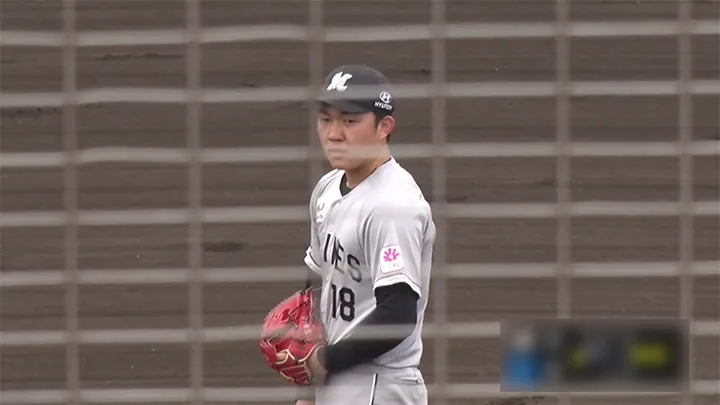
This was the comment received when I asked Lotte's Yuki Karakawa about the inside fastball that got Shintaro Masuda to ground out to the first baseman in the first inning of a game against the Rakuten Eagles' second team on June 8, 2018. The pitch type that Karakawa referred to as a slider at the time was actually the cutter that supported his pitch repertoire from the second half of that year until his retirement.
Regarding the slider (cutter) in the Rakuten Eagles farm team game on the same day, he said, "It had quite a bit of speed, and since my condition hasn't been bad for a while, I feel a sense of confidence in that regard."
After being converted to a reliever in the second half of 2018, he utilized a pitch style centered on his cutter; while he had a 5.48 ERA over 4 starts and 23 innings that year, he boasted outstanding stability as a reliever with a 0.36 ERA over 21 games and 24 2/3 innings.
At the time, Karakawa looked back and said, "I'm hardly throwing any fastballs, so I don't have much of a feel for it. I think of it as a slider, but it's a cutter. Yes." When asked if he became more stable after he struck out Laird with a cutter in a game against Nippon-Ham on August 31st of that year, he revealed, "Certainly, the ball I used to get Laird, whether it was a struck out or something, was good, and I've been playing with the image of wanting to throw that ever since."
February 2019, Ishigaki Island Spring Camp. When asked if his pitch would center around the cutter like in the latter half of 2018, he replied, "That won't necessarily be the case, but I think it's important for practice to first focus on throwing a solid fastball."
Even after the season opened, he mainly used his cutter, but he expressed his honest thoughts, saying, "It's not that I made a firm decision (to focus on throwing the cutter), but since it's only one inning, I feel like I'm throwing the pitches I have confidence in."
On the other hand, while he had feelings for his fastball, back in 2019 he threw with a particular focus on his cutter, saying, "Since I am a pitcher who throws the cutter as my main pitch, or rather quite frequently, I have my own personal commitment to it. It is because of that pitch that I am able to throw now, so I value it. I mean things like the strength of the ball and its trajectory. I do wish my control would get better, though."
In the latter half of 2018 and throughout 2019, he focused on his cutter, but during the spring camp in Ishigakijima in February 2020, he showed his intention to throw both by stating, "I plan to throw both my fastball and cutter." Regarding his fastball, he said, "I want to eliminate the difference between the initial and final velocity, and I am focusing on how I use my body and my mental image to achieve that."
That same year, the cutter remained the core of his pitch repertoire, but in a game against Nippon-Ham on August 14th of that year, he also struck out Yokoo looking with an outside fastball, later commenting, 'I think Yokoo was anticipating the cutter, which is why he ended up watching it go by.'
In 2021, the opportunities to throw the fastball increased, and in 2022, the ratio of fastballs increased further. There was a period when he used the cutter as the core of his pitch selection and stopped throwing the fastball because he felt it 'wasn't very effective,' but in a 2022 interview, he explained the reason for throwing the fastball again: 'I don't have much confidence in it, but since I sometimes pair with Matsukawa, the catcher who joined this year, it feels like he is selecting it to be thrown. I always want to throw a good fastball, so it's a continuation of that.'
Even after being reassigned to the starting rotation in the second half of 2023, he threw cutter, and occasionally fastball. In the game against the Seibu Lions on April 16, 2024, where he held them to one hit and zero runs over six innings—including a perfect performance through the fifth as a closer—he commented, "I wasn't throwing fastball, only cutter. Everything was a cutter. Because of the wind, the cutter component was high, which I think led to many fly balls and swings and misses." His cutter was masterful amidst winds blowing at over 10 meters per second.
Regarding the cutter, he said, "I'm not looking to get groundouts. I want to increase the hop component of the cutter, so for me, an out from a pop fly is more satisfying." He explained that his ideal way to get a batter out is "a high pop fly. The best thing is for the batter to think they've made solid contact, only for it to end up as a flyout."
In the same year, he would throw a cutter in the low 130 km/h range one moment and then one in the 140 km/h range the next, explaining, "It feels like I'm adjusting the intensity while throwing long innings. It's slower when I'm working the count and faster when I'm going for a finishing pitch; it depends on the situation." In this way, he also created variations in speed with his cutter.
"Since the cutter will be my primary pitch, I think it's necessary for me to take pride in working on it. After becoming a reliever, it became my best pitch, so I ended up throwing it more and more. Even as a starter, the fact that it remains my primary pitch hasn't changed," he said, showing his pride in his cutter.
◆ The pitch barometer
The cutter also serves as a barometer for his pitching. Having established himself as a starter in both the first and second divisions in '24, he analyzed himself by saying, 'Just as other pitchers might say their fastball is good, I think the way I utilize my other pitches changes accordingly. In that sense, I feel I am able to throw my cutter consistently.'
Looking back, he has maintained stable pitch performance during seasons when his cutter was sharp. Early this spring, he was unable to control his cutter as desired, and during the Rakuten Eagles farm team game on March 19, he noted, "Since I'm able to pitch by throwing my slider effectively while my cutter isn't very good, I think it's usable and has become one of my weapons," at times resulting in a slider-heavy pitch style.
In the minor league game against The Giants on May 8th and against Rakuten Eagles on May 15th, he performed as a closer with a pitch selection centered on his cutter, but he was not satisfied, stating, 'I think it's getting better compared to early spring, but there are still parts that aren't going exactly as I want, so I think I need to improve the precision in those areas.'
His pitch form also appeared to have changed since around the Rakuten Eagles farm team game on May 15th. He commented, "I'm going through a lot of trial and error, so I think it's changing slightly bit by bit. I am experimenting." When asked if the cutter was related, he tilted his head and said, "Yes, it's not just the cutter, but I feel like I'm searching for something good and checking the feel of things every day."
In The Giants' minor league game on July 18, he said, 'I am the type of pitcher who throws while observing the batter's awareness, swing, and reaction, and I think I was able to throw good pitches to good spots within that approach.' A highlight was the second pitch he threw to Shogo Asano with one out and no runner in the 4th inning while leading 2-0; after a 1-strike count, he threw a 145 km/h inside cutter that snapped the bat and resulted in a fly out to left.
Since entering August, he has been throwing cutter to the inside against left-handed hitter and right-handed hitter, stating, "I think it's actually difficult for any hitter to hit a ball that comes precisely to the inside, so I feel the ratio has increased because I know I can be the closer if I throw it there."
At the very end of the season, amid expectations for an appearance with the first team, he made the decision to retire. When I interviewed him in 2018, I told him his fastball was good, but pitcher Karakawa replied, "That was a slider. It had quite a bit of speed, so it's understandable you'd think that." From then on, I began to spend hours repeatedly checking footage of pitcher Karakawa's appearances. I would ask about changes, such as "That pitch to that player was a fastball, wasn't it?", "You've started throwing the change-up to right-handed hitters too, haven't you?", or "You've started throwing the splitter again, haven't you?" It made me happy when pitcher Karakawa would say things like "You're watching closely" or "Thank you," which gave me a sense of accomplishment and confidence. Yuki Karakawa has made the cutter the core of his pitch since the summer of 2018 in order to succeed on the first-team stage. It makes me feel lonely to think that there are only a few opportunities left to see that cutter.
Interview and text by Yuta Iwashita