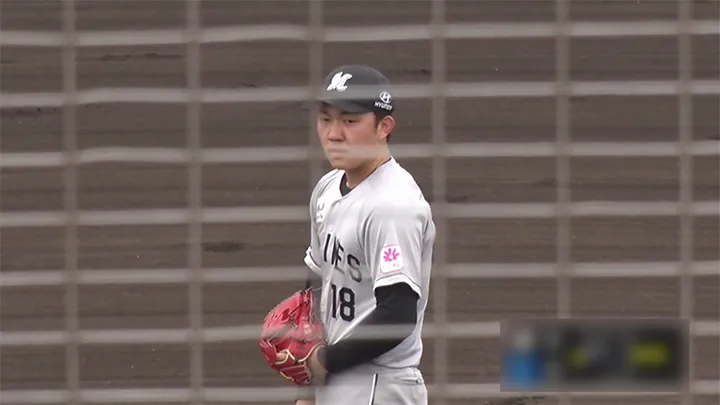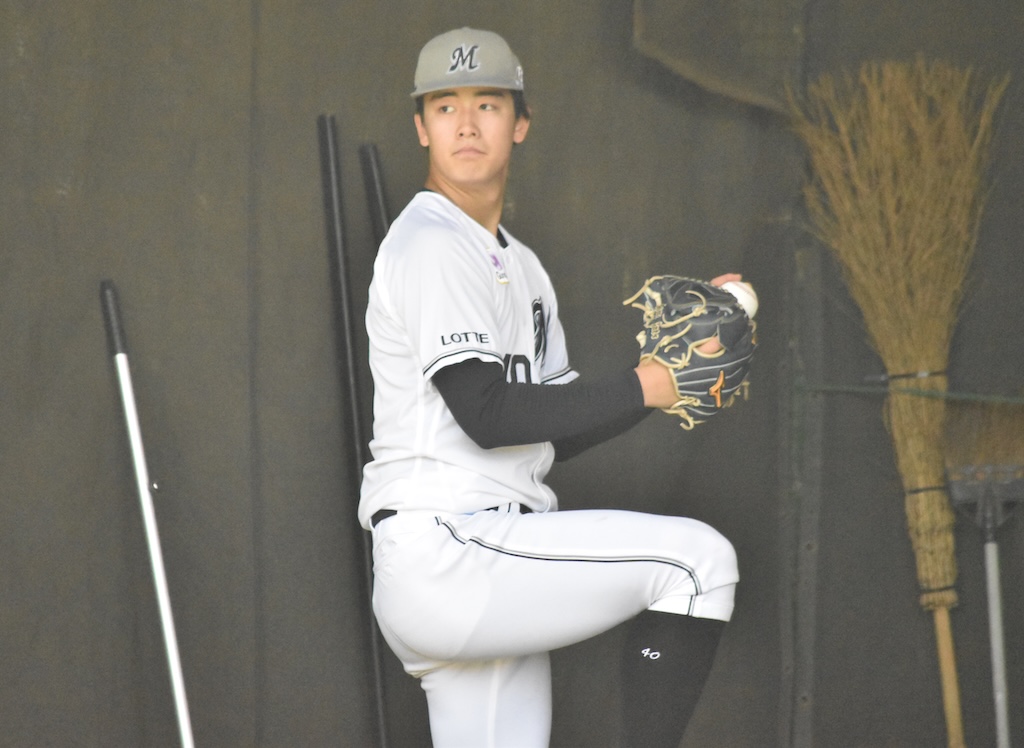
Lotte's third-round draft pick, Raito Okumura (Yokohama High School), made his first Walk in a minor regular season since the game against Oisix on June 17th against the Yomiuri Giants' The Giants league team on July 19th. Although he walked the leadoff hitter, he threw 15 pitches over one inning, allowing no hit, strike out two, BB one, and closer no runs.
In his recent appearances, he has been able to strike and miss at fastball. On July 19, in the The Giants second team game, with two outs and a runner on first in the 8th inning with a score of 5-2, he swung and missed on the first pitch to Shogo Asano, swinging at 141 km/h fastball, swinging fastball on the second pitch 142 km/h outside, and looking off on the third pitch, 144 km/h fastball, and retired struck out.
Ko Matsukawa, who will be playing with Okumura from the start of the season and will be forming a battery with him in the game Oisix on June 17, commented on Okumura, saying, "I think he has a really good fastball, but there is a difference between where he throws it and where it comes in compared to his breaking ball, so we've talked about him throwing it low towards catcher. We're working on that together, discussing it as we go."
Okumura said, "Mr. Matsukawa told me that I should pay more attention to the height of my pitches than the location, so I kept that in mind and focused on the height during the last game. I was able to throw the ball to the right location and at a low height, where Avg was low, so I think it was good that I was able to take his advice to heart and put it into practice." He put Matsukawa's advice to good use during The Giants' minor league game.
Regarding his fastball, he revealed, "I think the most important thing is to throw with all my might without trying to throw strike, so I don't focus on control or trying to throw it to a good spot. The most important thing is to throw my ball into strike zone. That's what I focus on."
In breaking ball on the same day, in Game The Giants, with the score 5-2 in the eighth inning with no outs and a runner on first, the third pitch, the 124 km/h change-up, which induced a swing and miss to Richard on a 1-1 strike, was a good breakthrough. The fourth pitch, the 123 km/h change-up, where he induced the next swing struck out, was a good drop from the strike zone to the ball zone. change-up is throwing the count pitch and the strike pitch separately—--
"I do vary my pitches to some extent, but I find it easier to control when the movement is less. When I was ahead in count and going for the strikeout pitch, I had the advantage in count, so I went for the drop and was able to get struck out."
As for other breaking ball pitches as well, “Lately, the probability of getting strike with breaking ball has been increasing, so if your fastball is on point, breaking ball tends to work well too—or rather, I get the impression that if you can throw a fastball, you can also throw breaking ball.”“If my fastball is in the zone, I feel like I can throw breaking ball at any time. Since my strike rate has gone up recently, I think the rate at which I can throw breaking ball and strike—and the probability of them hitting my target—will also increase,” he analyzed.
He's been clearing his challenges and showing improvement with each appearance on the mound. "I think my strength is my fastball that can get swings and misses, so I'll continue to work on that, but I also need to eliminate Walk. I think Walk are the biggest waste, like the one I gave up the other day, so I'd rather give up a hit, or rather, it gives me a better rhythm, so I want to be able to challenge the batters in the strike zone and pitch well." In that context, was it a positive takeaway from his last appearance, when he walked the leadoff hitter but still managed closer them Walk?
"Even after allowing runner on base, I was able to continue pitching consistently. Quick pitching has been an area I've been working on, so being able to throw it well is a positive takeaway."
I'm currently working on my goals every day in order to succeed on the first team stage in the future.
Interview and text by Yuta Iwashita