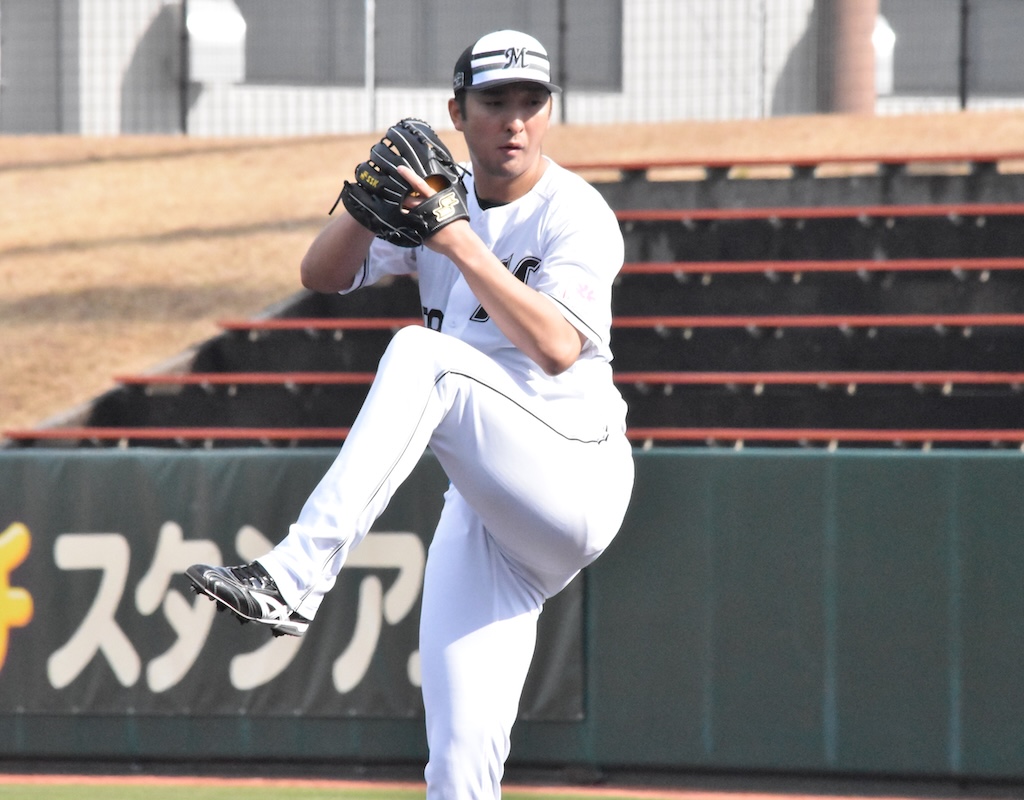
Lotte's Tokito Kawamura is beginning to overcome his long-standing issue of "runs."
In Rakuten Eagles minor league game on May 5th and Seibu Lions minor league game on May 23rd, he gave runs in the first inning, showing some instability at the start of games. In an interview on May 26th, he said, "I'm trying different things, like how I use my time, how many pitches I throw, and changing the number of pitches I throw in bullpen before the game, and changing the order of my warm-up. I think the first inning is quite a challenge."
He showed this pitch in the farm team by getting through the first inning and closer quickly with fewer pitches from the second inning onward. In his second first-team start of the season on June 24 against Nippon-Ham, he gave up a timely doble to Kotaro Kiyomiya in the first inning, but in the Rakuten Eagles game on July 1 and the Nippon-Ham game on July 8, he closer the first inning without runs.
Did they finally find a good way to start the game after all the trial and error they went through in the initial stages?
"I'm conscious of how I approach the first pitch and how I face it, and I try to throw it well."
In his previous start against Nippon-Ham, he said, "They have a lineup that can hit home run runs, so I think my choice was to try to get them to hit ground balls as much as possible." In the first inning, with the score 0-0, he threw a 142 km/h inside slider to Shun Mizutani, on the second pitch after one strike, which resulted in a fly ball to right field. In the first inning, with two outs and no runner on base, he threw an inside slider to Reyes on the second pitch after a 2-ball, 2-strike, which resulted in a fly ball to center field. Although they were fly outs, he was aggressive in throwing sliders to the inside corner to right-handed hitter from the first inning.
He said he wanted to get the batter to hit a ground ball, and in the second inning with two outs and the bases bases loaded, with the score 0-1, he got Mizutani to hit a ground ball to the shortstop with a 144 km/h inside slider on the second pitch after a ball. But is this the ideal way to get a batter out?
"I think it was a shot. It was ideal."
His shooting is good, but fastball also threw powerful pitches, saying, "My average velocity has improved, so my feel is pretty good. It's not bad for me."
Getting back to the start of the game, in the July 1st matchup against the Rakuten Eagles, he threw 45 pitches through the first two innings, but retired the side in order in the third, fourth, and fifth innings—three inning—and ended up pitching seven innings.Just as he did in the minors, once he got past the early innings, he was able to cruise through long inning innings with a low pitch count.
"I threw a lot of pitches early on, and since I wanted to pitch for as many inning as possible, I tried to closer my pitch count down a bit, but we did manage to score some runs, so I think that was the result of me focusing more on the strike zone."
In the game Rakuten Eagles that day, with two outs and no runner in the fourth inning leading 2-0, he retired Ryuya Taira on the fifth pitch with a swing struck out from 1-ball, 2-strike, and a 134 km/h fork on the fourth pitch, where he struck a swing struck out on a 1-ball, 2-strike lead-off Fumiya Kurokawa in the 7th inning, and the 130 km/h fork on the fourth pitch was good.
"I've been getting swings and misses with fork, and although I didn't get many struck out in the last game (against Nippon-Ham), I got quite a few swings and misses along the way, so I think it can become a good pitch depending on how I use it and the timing."
What's interesting is that he seems to throw more cutter than slider. "It varies from day to day," he said, adding, "The cut fastball is a convenient pitch, but I try not to throw it too much." He explained the reason for this, saying, "If I don't keep my fastball as my main pitch, fork won't be effective either, so sometimes I'll throw a cut fastball when I should be throwing a fastball, but I make sure not to forget about my fastball."
After posting consistent pitch in the minors, he made his second first-team start on June 24 against the Nippon-Ham, where he pitched 5 innings with 6 runs, resulting in a lose pitcher. However, on July 1 against the Rakuten Eagles, he pitched 7 scoreless runs, and on July 8 against the Nippon-Ham, he pitched 5 innings with 1 runs, helping his team stay in the game.
"I'm able to do what I want to do. Of course, the level of the batters is high, but we also have more data than in the farm league, and if I pitch based on the data they've provided me with, I think I can manage somehow."
Consistent pitch is the key to securing a starting position. Regarding what's important for becoming a regular starter, he analyzed himself, saying, "Manager Saburo doesn't see hits as much of a negative, but Walk and throwing too many pitches because my rhythm is disrupted are very detrimental, so I think it's important to throw strikes with good strike."
"I want to stay on the first team for as long as possible. The team is on a roll right now, so I hope I can rise along with the team." With the starting rotation being inconsistent, they need at least one player to establish himself in the rotation. He's determined to seize this opportunity this summer.
Interview and text by Yuta Iwashita