I object to Rakuten Eagles 's Mikitani-style team restructuring [Musings on the White Ball]

Baseball King

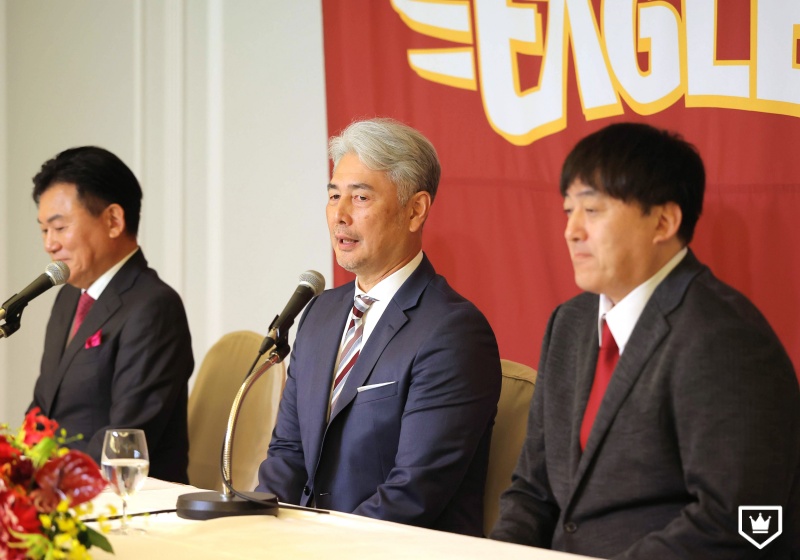
Rakuten Eagles Eagles' new manager, Masato Yoshii (left: owner Hiroshi Mikitani, right: general manager Kazuhisa Ishii) (C) Kyodo News

◆ Baseball Musings 2026, Part 25

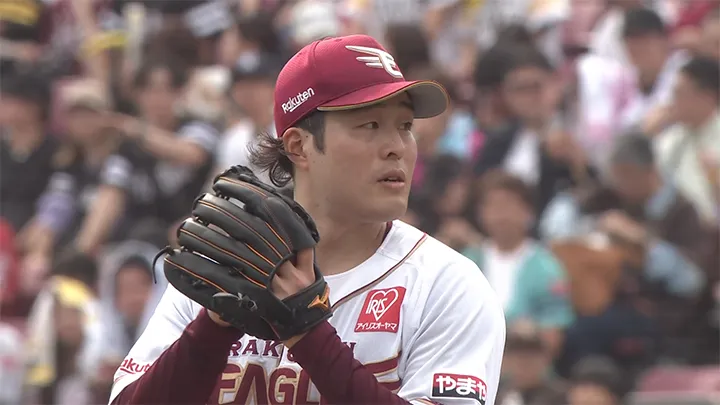
It's been almost a week since Masato Yoshii was appointed manager of Rakuten Eagles.

Coincidentally, his return game was against his former team, Lotte, where he had managed until last year.

Due to rain cancellations, the three-game series was reduced to two, but the result was two consecutive losses. Including the period under former interim manager Tatsuya Shiokawa, this marks the sixth time this season that the team has suffered five consecutive losses, and their slump continues.

A press conference announcing the appointment of the new manager was held on the 16th of this month.

This comes just six days after the announcement of former manager Hajime Miki's leave of absence and the appointment of Shiokawa as interim manager. It is said to be the "first time in history" that a manager has been invited from outside the team and appointed during the season. Furthermore, team owner Hiroshi Mikitani was present at the press conference. This is the first time in 16 years that the owner has attended a managerial appointment press conference, since Senichi Hoshino. Many in the media are reporting this as a sign of the owner's seriousness in carrying out a team reform this time.

Both the person entrusting the command of such a fleet, like a sinking shipwreck, must have required immense courage.

Owner Mikitani said, "It's a long shot. I think it's like picking chestnuts out of the fire," to which new manager Yoshii replied, "At first I was really hesitant, but after hearing what the owner had to say, I decided to do it and I've been prepared for it ever since," accepting the unusual mid-season appointment.

At the press conference, the owner did not mention details such as the length of manager Yoshii's contract, saying, "It's a medium- to long-term contract. I want him to instill a winner's mentality." He also announced a plan to completely overhaul the team, stating, "We will invest heavily in all aspects—facilities, organization, and personnel—to make this the strongest team in every sense of the word."

However, I can't bring myself to believe in Mikitani's plan 100%.

Regarding the "organizational aspects" and "human resources aspects" mentioned earlier, what steps have been taken so far, and what lessons have been learned? Without a clear summary before making a major investment, both the investment and the strongest team could end up being nothing more than wishful thinking.

Let's take a recent example. Just one week before the appointment of new manager Yoshii, it was announced that former manager Hajime Miki would be taking a leave of absence. Discussions were held immediately after the team's loss to The Giants in the interleague series, and the announcement was made at 1 a.m. on the 10th. There was no press conference; it was a unilateral announcement by the team.

While there may be questions about former manager Miki's qualities as a leader, he did step in to take charge in 2020 and 2025, essentially acting as a pinch hitter during the previous manager's difficult times. For the team, it's a corporate culture to announce the leave of absence of such a valuable contributor with just a piece of paper, and in the middle of the night at that.

Since the team's founding in 2004, it has produced a total of 10 managers, but six of them—from the first manager, Yasushi Tao, to Marty Brown, Hiromoto Okubo, Yosuke Hiraishi, Toshiaki Imae, and Miki—have been replaced within one or two years. Over time, this hasty personnel change has led to rumors circulating that "nobody wants to be the manager of Rakuten Eagles."

Even with this change in manager, General Manager Kazuhisa Ishii, who should have played a major role, has remained silent and failed to fulfill his accountability. If they are going to proceed with "personnel reforms," it will be meaningless unless they change these bad practices first.

Looking at former manager Miki's words and actions this season, there were many reports of him being evasive when asked about the starting lineup or strategy, saying things like, "Ask someone else." Some former baseball players even say that instructions regarding player selection and strategy were coming from someone other than the manager. With this kind of behavior, no matter who becomes manager, they won't be able to last long.

New manager Yoshii is a renowned mentor who, as a pitcher coach, nurtured pitcher like Yu Darvish, Shohei Ohtani, and Roki Sasaki. However, he is also a craftsman at heart, having frequently clashed with managers over player usage during his time as a coach. While Rakuten Eagles has described this as a "medium- to long-term contract," if the team interferes unreasonably again, it cannot be ruled out that he might leave in anger. A major organizational reform will likely be necessary in this situation.

As an example of a team reform that emphasizes data, owner Mikitani cites the success of Vissel Kobe, the soccer team he also owns.

Indeed, the emphasis on data has become prominent in baseball in recent years, significantly impacting strategy and tactics. However, "data-driven baseball" is spreading not only among Rakuten Eagles but among all 12 teams. It's not just about using computers; how to utilize that data and implement it effectively for the players is a human matter. Building a roster capable of competing to a certain extent is the priority; data alone won't produce good results.

In the business world, Mikitani is in fierce competition with Softbank Hawks owner Masayoshi Son. Son has an expert he can rely on, Sadaharu Oh, chairman of the baseball team. Because Mikitani lacks such a strong supporter, he is called a "one-man owner," and critical voices are not easily heard.

As of the 21st, their record is 23 wins, 42 losses, and 1 draw. They are burdened with all the losses in Pacific League, and are nowhere near the back of the 5th-placed Lotte Marines.

If we want to make the most of the remaining games, we must first address the root cause of the problem and take the first step towards reform.

Text by Kazuo Arakawa

Featured
Featured
Pacific League News

I object to Rakuten Eagles 's Mikitani-style team restructuring [Musings on the White Ball]