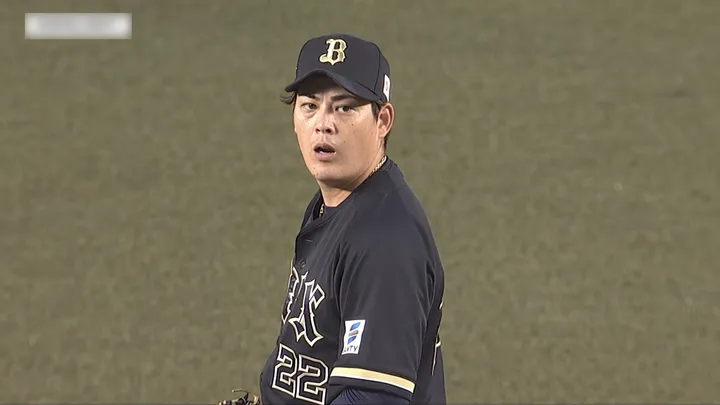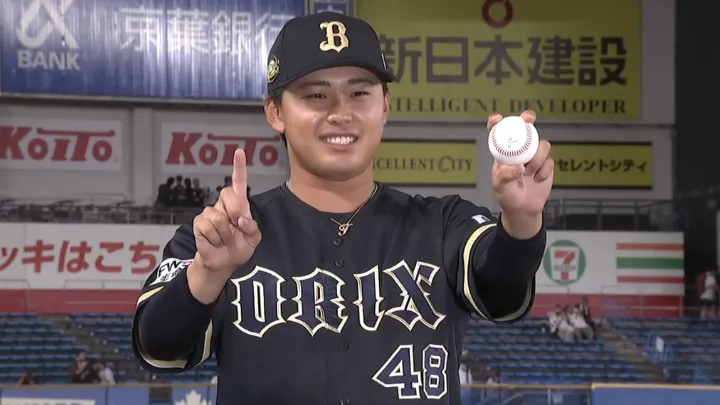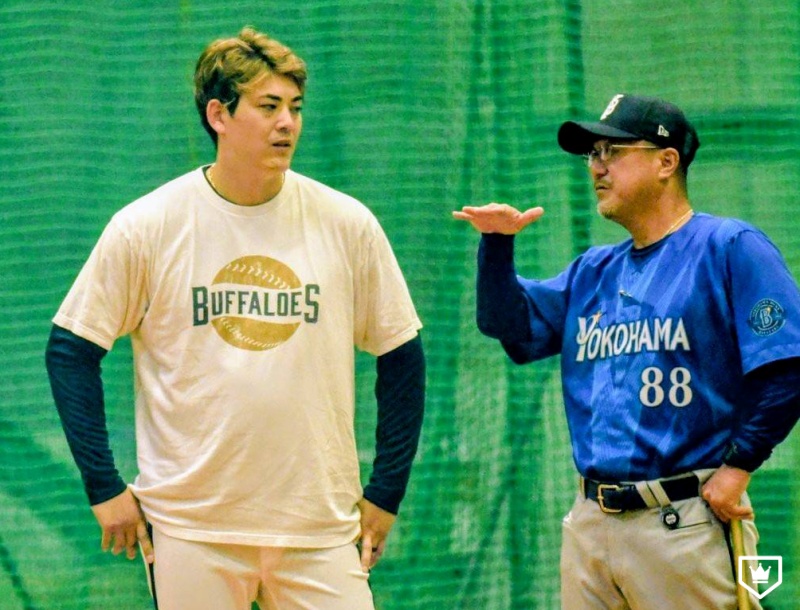
DeNA coach Yusaku Iriki has been watching over Orix Buffaloes pitcher Alen Kuri Kuri, who closed out the final game of the interleague series with a start on only four days' rest, with great confidence.
"To pitch after only four days of rest is impressive. It's remarkable. He's now the ace of Orix Buffaloes." Coach Iriki exclaimed in surprise towards the end of the interleague series.
Coach Iriki joined The Giants in 1996 as the first overall pick in the draft, after graduating from PL Gakuen (Osaka), Asia University, and Honda Motor Co., Ltd. Known for his dynamic pitching form and aggressive approach to hitter, he served as a long reliever and closer. After transferring to Nippon-Ham, he also tried his hand at MLB and ended his playing career with Yokohama (now DeNA). Subsequently, he served as a pitcher coach for Softbank Hawks and Orix Buffaloes, and currently works as the chief pitcher tactics and development coach for the DeNA minor league team, guiding young pitcher. Kuri joined the Hiroshima Carp in 2013 as the second overall pick in the draft, after graduating from Okayama University of Science High School and Asia University. He exercised his domestic free agent (FA) rights and has been playing for Orix Buffaloes since 2025.
The two, both graduates of Asia University, reunited this past April. Coach Iriki was visiting the Orix Buffaloes' minor league facilities for an interleague game when Kuri, who was preparing for his next start, came to say hello. Their conversation lasted for over 20 minutes, and even from a distance, it seemed like they were having a heated discussion about baseball, with Coach Iriki demonstrating his swings with a bat.
According to Coach Iriki, "Allen (Kuri) taught me the importance of throwing high." "In today's baseball, pitching often involves throwing high pitches more often than in the past. In the past, it was often said that batters should 'hit the ball in the shortest distance,' and I think there were many hitter swung compactly at high pitches. Now, there are many hitter swing from below with a big swing, and surprisingly, quite a few hitter get jammed by high pitches. There is a weak point in high pitches. That's why I tell (young pitcher) to use high pitches."
Kuri's answer was reportedly unexpected. "I think it's difficult to aim high for high pitches, so as a guideline, we aim for the belt level. I don't think Allen throws fastballs high, but there are still a few pitches in a game that go high up. The way he aimed at that time was a very heavy task for him. "It was a persuasive phrase, so I was really happy," said Coach Iriki. If it's too high, hitter treats it as a ball and doesn't touch it. When told to aim for higher pitches, it's easy to think you have to throw high. If you aim high and go in too softly, you risk being hit hard; if you miss high, it becomes a ball. It seems that within the strike zone, how to get hitter to swing the bat was part of Kuri's awareness of the higher pitches.
"When pitcher talk about throwing high, they often imagine a high pitch that's far from strike zone. pitcher even think of it as a complete ball. strike zone starts from under the armpit, but the umpire don't really call it that far. However, for hitter bring their bats up from below, a ball around the belt is quite effective as it's a ball they can't quite connect with, resulting in fouls or swings and misses. So when Kuri said, 'Throw at belt height,' it really made sense to me. I thought it was interesting, a great thing to say. I had a great time." Even though they were conscious of throwing high, the question remained: at what height and with what mindset? Kuri's words, 34, who provided answers to this vague question, resonated with 53-year-old coach Iriki. Kuri's words were immediately conveyed in a meeting and led to a change in the young pitcher' mindset.
Coach Iriki says that about 15 years ago, he taught Kuri, who was a student at the time, "the importance of throwing low." "When I went to Asia University to watch practice, Kuri was practicing pitch. Even back then, he was pitcher who could throw low carefully. I gave him all sorts of advice, like, 'This is why you should try so hard to throw your fastball low, and this is what it means to throw low.' I don't know if Allen remembers it, though," says Coach Iriki.
Kuri recalled, "He told me that if I could consistently throw the ball low and spread it out to a certain extent, I could control the game to some extent, and if I was in trouble, I could throw it there and compete with hitter. I thought that having the confidence to throw it low while practicing was a plus. It might be reflected in my current pitching style." It seems that the advice he received back then is now being put to good use in his versatile pitch style, which involves concentrating various pitches low in the strike zone.
"Do you remember (that time)? I've been watching you work hard ever since, and I've always thought you were reliable. You're physically strong. Yasuaki (Yamazaki Yasuaki, pitcher DeNA), who is also from Asia University, is strong, but he went from Asia University (where the training is tough) to the Carp (laughs)."
Kuri pitched in four games during the interleague series, recording one win and one loss with a 2.55 ERA and a league-leading 30 strike out. In regular season, he has pitched in 12 games, with a 5-4 record and a 2.76 ERA, ranking 7th in the league. Coach Iriki, who has stepped away from mound to become a coach, believes that "daily updates are necessary." He was deeply moved to see his junior teammate continue to perform at the forefront of pitch for so long by following his advice, and now providing feedback based on his on-field experience.
Interview and text by Masaki Kitano