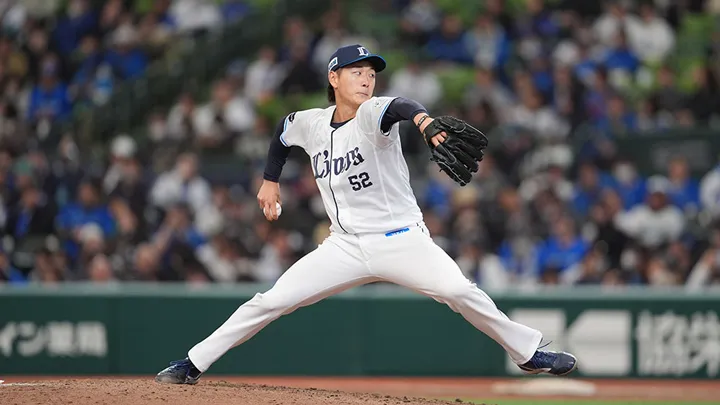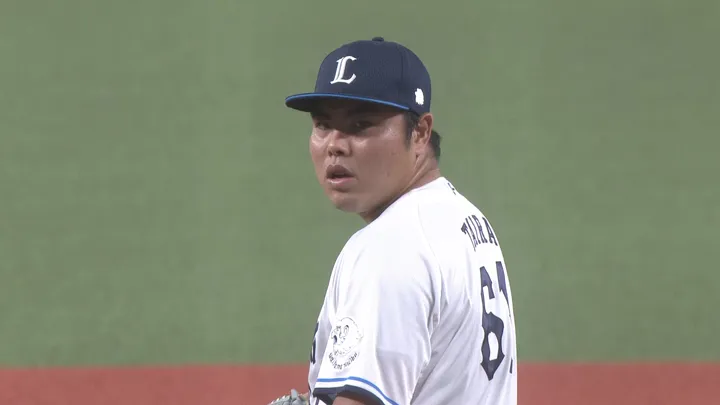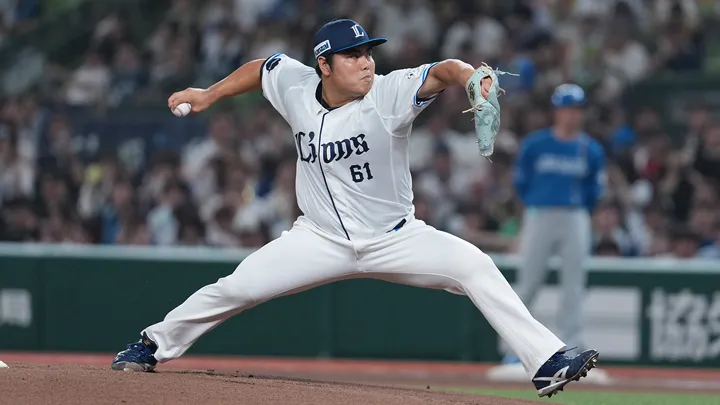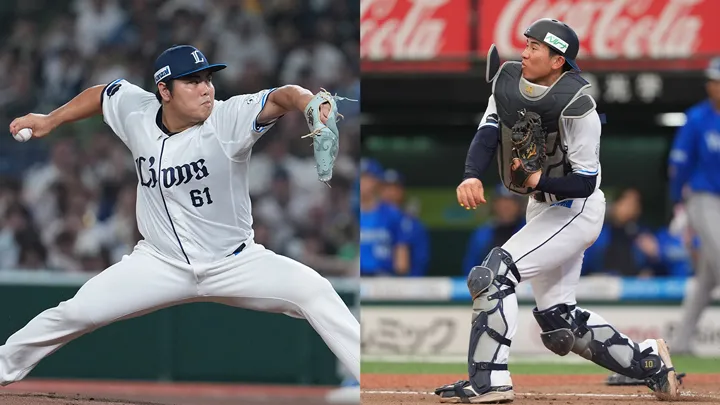
After finishing the 2025 season where he won the most saves as a closer, Saitama Seibu Lions pitcher Kaima Taira converted back to a starter this season. He won the monthly MVP for March and April with a performance that recorded 26 consecutive inning without an earned runs from the opening, and continued to lead the starting rotation with outstandingly stable pitching thereafter. Ultimately, he marked a strong record of 12 wins, 5 losses, and an ERA of 1.36. This time, we will analyze the pitch style the right-hander showed as a starter this season.
The fastball, reaching a maximum speed of 160 km/h, is just one of the many types of pitches in the repertoire.
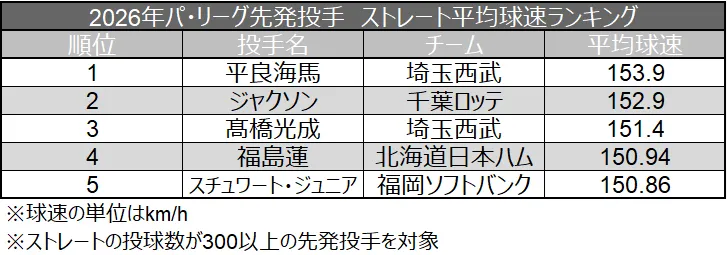
Taira's pitcher boasts a top fastball of 160 km/h. He first recorded 160 km/h in his third year as a pro in 2020, his third year in the first team. Since then, he has frequently recorded records as a reliever, but this season he has reached this milestone for the first time in his career as a starter. His average pitch speed of 153.9 km/h is the highest in Pacific League starter this season, and there is no doubt that this blazing fastball is his greatest weapon.
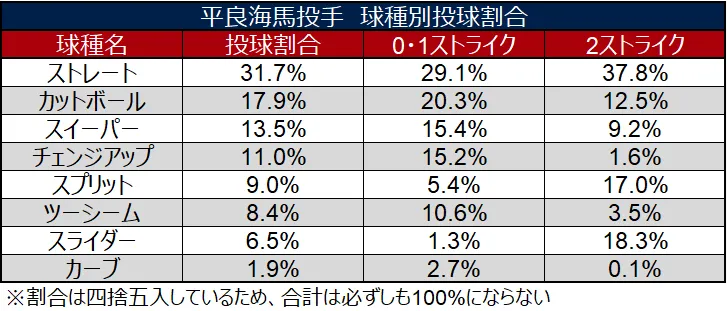
However, this season's fastball pitch ratio has remained at about 30% of the total, and despite possessing one of the best speedballs in the league, he has been shutting down hitters with a pitch style that utilizes a wide variety of pitch types. Furthermore, looking deeper into the data, it becomes clear that pitcher Taira gives each pitch type a distinct role. First, looking at the pitch ratio by strike count, the ratio changes completely before and after putting the hitter in a hole, showing that he uses the fastball, slider, and splitter as his finishing pitches.
Three winning shots that boast a high swing-and-miss rate

A 14.8% whiff rate on the fastball is a top-class figure in NPB, even when including relief pitchers. In addition to the previously mentioned velocity, the pitch location is a factor contributing to this high whiff rate. Pitcher Taira has a stronger tendency than other pitchers to cluster his fastballs in the high zone, and he states that his intention is to aim for swings and misses. In fact, by throwing high-velocity pitches into the upper zone, he is making batters swing through the air, showing that his pitching intent and results are perfectly aligned.
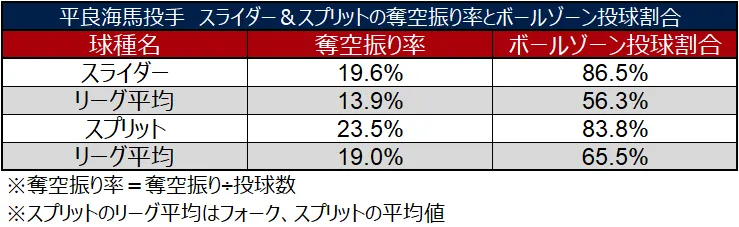
Among the breaking balls, the slider and splitter are used as winning shots. While the pitch percentage for both is less than 10% before getting ahead in the count, the percentage rises to nearly 20% at two strikes. Their swing-and-miss rates are 19.6% for the slider and 23.5% for the splitter, both significantly exceeding the league average, making them highly effective pitch types for getting struck out. Similar to the fastball, the pitch locations for these two types are distinctive, with over 80% being thrown into the ball zone, indicating that their role as finishing pitches is thoroughly established.
The function as a count pitch changes depending on the type of pitch.
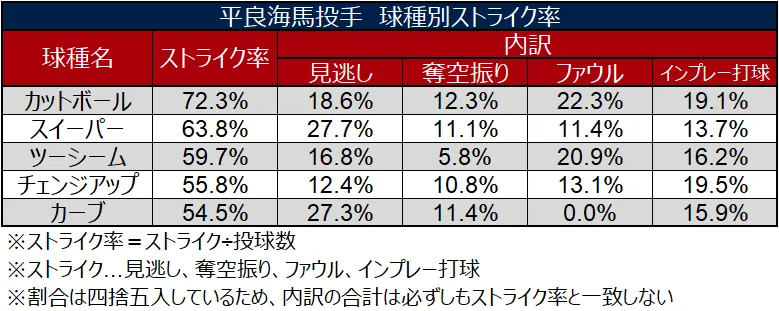
Next, let's look at the other breaking ball. The aforementioned pitch types have a high pitch rate before reaching two strike and are used as so-called count pitch. Among them, the cutter has the highest strike rate. This breaking ball, which is fast with an average velocity of 146.8 km/h, can jam hitter to induce fouls and also generates many swings and misses. It is the most effective pitch type for getting strike count and is used regardless of whether the hitter is right-handed or left-handed. The two seam fastball, which can similarly push hitter with speed, is also a pitch type with a foul rate exceeding 20%. While it generates few swings and misses, it can induce ground balls with a ground ball rate of 64.5%, making it a powerful tool for getting right-handed hitter out.
On the other hand, the sweeper and curveball, which are the slower balls in his repertoire, are pitch types that can get strike via called strike. In particular, the sweeper has a pitch rate that is the third-highest after the fastball and cutter, adding an accent of speed variation to pitcher Taira's pitching, which primarily uses power as a weapon.
The change-up is faster than the splitter, which is another vertical breaking ball, and accordingly has a more modest drop; it is thrown primarily to induce contact rather than to aim for swings and misses. In this season's pitch, the rate of balls in play was higher than other breaking ball, achieving the intended results. However, the ground ball rate of 51.1% is around the league average, and the Avg is somewhat high at .280. There may be room for improvement in its precision and usage.
He disposes of the hitter with a wide variety of pitches.
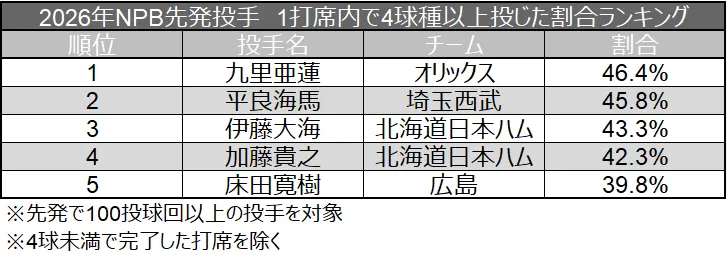
Pitcher Taira, who possesses eight types of pitches, competes with hitters by using them without hesitation. The percentage of plate appearances in which he threw four or more types of pitches was 45.8%, the second highest among NPB starters this season after Orix Buffaloes pitcher Alen Kuri. This means he can finish off hitters by using a variety of pitch types depending on the opponent and the situation. Conquering this pitcher will be an extremely difficult task for any batter.
Despite having established a solid position as a reliever, pitcher Taira had long expressed a strong commitment to being a starter. This season, having successfully returned to the starting rotation as he wished, he contributed significantly to the team's high ranking by winning the best ERA title. He proved his value once again and announced his intention to challenge MLB via the posting system this off-season. No matter where the stage is next season, he will surely show us pitching that overwhelms hitters, freely manipulating his powerful fastball and diverse breaking balls.
※All figures in the text and tables are as of the end of the 2026 season
Text by Data Stadium