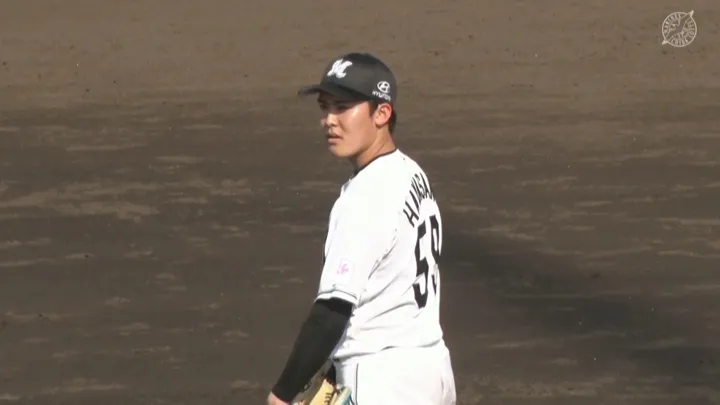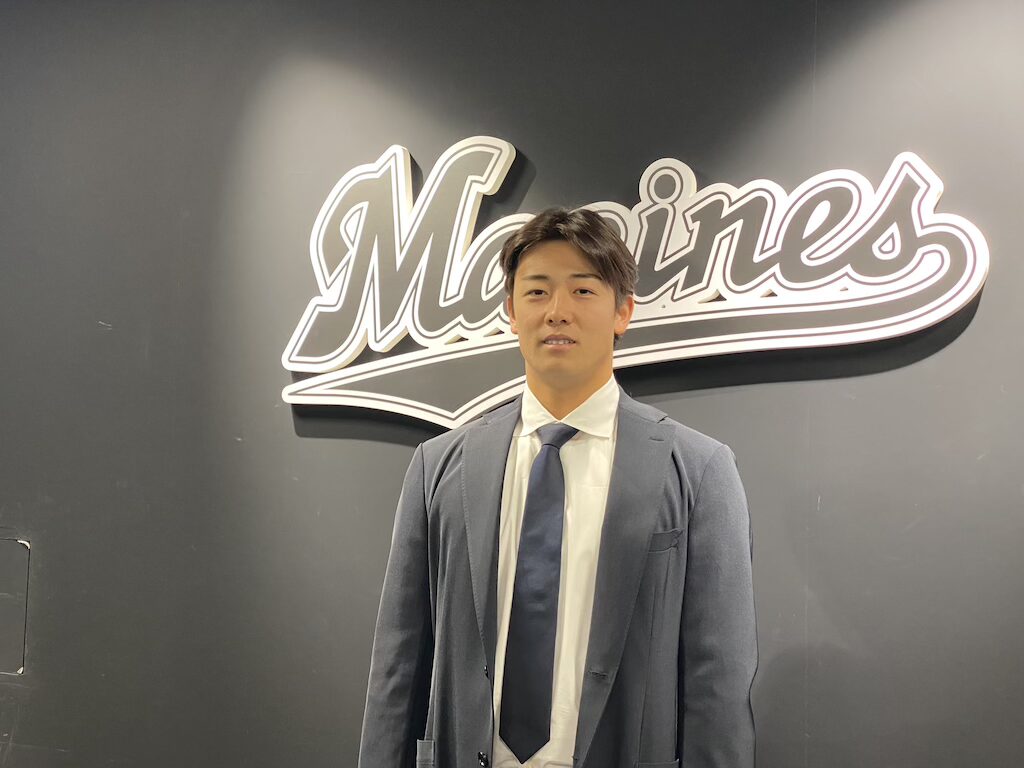
My body has gotten much bigger, and my velocity has increased since high school. Since the intervals between my appearances were quite long, I focused on training hard and repeatedly applying the results of that practice in games. I was able to go through the entire year without any injuries or being sidelined.
Lotte's Raito Okumura looked back on his first year of professional life in this way.
In early spring, Okumura was frequently seen actively asking questions to senior pitchers during pre-game practice for the minor league. He said, 'It's not just about ball speed, but also physical strength. On the day of the interview, April 25th, I had the chance to play catch with Ojima-san. Since I've been able to actively ask questions to seniors whom I wouldn't normally get to talk to, I think listening to various people is helping me expand my repertoire.'
When asking questions to senior players like Kazuya Ojima, who has reached the required number of innings pitched for five consecutive seasons until last year, do they think about what they're going to ask beforehand?
"I try to ask people about their thoughts and feelings, and I listen to see what kind of answers I get."
"The senior players at Lotte are very helpful and will answer any questions I have. For example, there are senior players from the first team at the training sessions, so I hope to be able to ask them questions as I go along."
Regarding what he felt while watching the senior pitchers practice, he gained insights from the individual practice sessions they conducted outside of team practice, stating, 'I can see their individual characteristics in the way they practice outside of team sessions, so I think I can learn from that.'
During the stay-behind practice for the first-team starters, when the first-team starters entered the bullpen, he observed them and also had the veteran pitchers watch his own pitches in the bullpen.
"I've been watching (my seniors' bullpen) and having Kojima (Kazuya) watch me. I think I can learn something by having people with various experiences watch me, rather than just relying on my own feelings, so I'm asking a lot of questions as I go along. I think being able to ask a lot of questions and see what works and what doesn't is one of the advantages of being a high school graduate. I think I can still make mistakes, so I want to try out a lot of different things."
The First Step Toward Becoming a Professional
"I think I've been able to take the first step, and I'm glad that I've been able to get this far without any major injuries."
On May 10th, he made his minor league regular season debut in a game against The Giants. Okumura, who took the mound in the 6th inning with the score tied 3-3, struck out the lead-off batter Shinnosuke Yamase swinging on a 120 km/h change-up on the fourth pitch after a 2-strike count. He marked his first out in the pros with a strikeout. The following batter, Takuya Kori, hit a fastball into left field for a hit, and Dai Yuasa drew a Walk after a 10-pitch battle. Although he faced a crisis with runners on first and second, he got Rui Mitsuzuka to hit into a double play on a second-pitch slider after a 1-strike count. In his first minor league regular season appearance, he pitched 1 inning with 18 pitches, allowing 1 hit, recording 1 strike out, 1 BB, and 0 runs.
Regarding breaking ball that day, including striking out Yamase with struck out change-up, Okumura reflected, "I didn't throw many breaking ball in high school, so while my breaking ball is important, I don't think I can rely solely on it. I need to hone my off-speed pitches. In that sense, getting a swing and a miss gave me some confidence."
On the other hand, regarding fastball he had honed during his high school days, he was not satisfied, saying, "I can get foul balls with it, but I can't get swings and misses, so I think I still have a lot of work to do to improve it."
His second appearance on May 27 in the Chunichi second team game was at mound of the first team's home ground, Zozo Marine Stadium. "It was my first time pitching and it had been a while since I last pitched at night, so I was a bit confused, but I was able to regain myself and pitch properly. I got two struck out, so I think that was a good thing," he said, throwing 13 pitches in one inning with 13 pitches, including two struck out pitches, allowing 0 hit, 2 strike out, 1 BB, and runs a clean pitch.
In his third appearance on the mound, against Yakult Swallows' minor league team on June 7th, he took Walk in the 5th inning with the score 2-4. With one out and no runner on base, he walked Seiya Hashimoto and then gave up a timely doble to Naoki Matsumoto, resulting in his first professional runs allowed. Nevertheless, he got Ren Sawai to ground out to third base and Ruito Nishimura to ground out to second base, limiting the runs to just one run in the inning.
Regarding the game Oisix on June 17th, he said, "My previous outing wasn't very good, so I was able to identify several areas for improvement and correct them, which resulted in a better performance." He threw with a quicker delivery even when there were no runner on base. He threw 15 pitches in one inning, 12 of which were fastball, and closer the opponent runs with his powerful pitching.
In that day's appearance, he formed a battery with Ko Matsukawa. Regarding Okumura, Matsukawa evaluated him by saying, 'I think he has a very good fastball, but there is a difference between where he throws it—or rather, where it comes in—and his breaking ball. So, we've been talking about how it would be good if he could just throw it low toward the catcher. I think we are working on that while discussing it together.'
Okumura said, 'Matsukawa-san told me that I should focus more on the height of the pitches rather than the location, so I kept that in mind during the recent game. I was able to keep the pitches low in areas where the Avg is low without missing the location, so I'm glad I followed his advice.' He applied Matsukawa's advice during the game against The Giants' second team on July 19th.
In the minor league game against The Giants on the same day, with a score of 5-2 and two outs in the eighth inning with a runner on first, he induced a swinging strike from Shogo Asano with a first-pitch 141 km/h fastball, followed by another swinging strike on a 142 km/h outside fastball for the second pitch, and finally struck out the batter looking with a 144 km/h fastball on the third pitch.
Regarding his fastball, he revealed, "I think the most important thing is to throw with all my might without trying to throw strike, so I don't focus on control or trying to throw it to a good spot. The most important thing is to throw my ball into strike zone. That's what I focus on."
In breaking ball on the same day, in Game The Giants, with the score 5-2 in the eighth inning with no outs and a runner on first, the third pitch, the 124 km/h change-up, which induced a swing and miss to Richard on a 1-1 strike, was a good breakthrough. The fourth pitch, the 123 km/h change-up, where he induced the next swing struck out, was a good drop from the strike zone to the ball zone. change-up is throwing the count pitch and the strike pitch separately—--
"I do vary my pitches to some extent, but I find it easier to control when the movement is less. When I was ahead in count and going for the strikeout pitch, I had the advantage in count, so I went for the drop and was able to get struck out."
As for other breaking ball pitches as well, “Lately, the probability of getting strike with breaking ball has been increasing, so if your fastball is on point, breaking ball tends to work well too—or rather, I get the impression that if you can throw a fastball, you can also throw breaking ball.”“If my fastball is in the zone, I feel like I can throw breaking ball at any time. Since my strike rate has gone up recently, I think the rate at which I can throw breaking ball and strike—and the probability of them hitting my target—will also increase,” he analyzed.
In the first half of the season, he pitched 5 innings across 5 games, allowing 2 hits, recording 6 strike outs, and posting a 1.80 ERA. In his first regular season appearance for the farm team after the Fresh All-Star game on August 27th against the DeNA farm team, he pitched multiple innings for the first time, but he fell behind in counts and his pitch count rose to 52 over 2 innings, allowing 4 hits, 3 BB, and 3 runs.
He appeared in three games in September, and his pitch style of pushing with his fastball was prominent. In the Hanshin Tigers second-team game on September 5, where he acted as a closer for one inning with zero runs, 11 out of 13 pitches were fastballs. In the DeNA second-team game on September 19, where he acted as a closer for one inning with zero runs, 13 out of 14 pitches were fastballs. In the Oisix game on September 27, where he allowed one runs in one inning, it was a power struggle with 32 out of 34 pitches being fastballs.
Regarding the difference between high school and the pros, I think there will be an environment where data is measured more. When I analyzed my own data to figure out what my weapons were, I realized that vertical movement was more of a strength for me than for other pitchers. I explained the reason for my pitch selection, which centered on fastballs, by saying that I intended to increase my fastballs to polish that strength.
In the Miyazaki Phoenix League held in October, he pitched in four games and threw two innings in three of them.
While the "high school graduate group" including Genki Ishigaki, Yuya Sakurai, and Ryoju Okamura made their first-team debuts, he did not have an appearance with the first team. "I think that without a first appearance and a first win with the first team, there is no 1 and therefore no 2, so I want to do my best to achieve that first step." Next season, he wants to make an impression starting from early spring and achieve his professional debut.
Interview and text by Yuta Iwashita