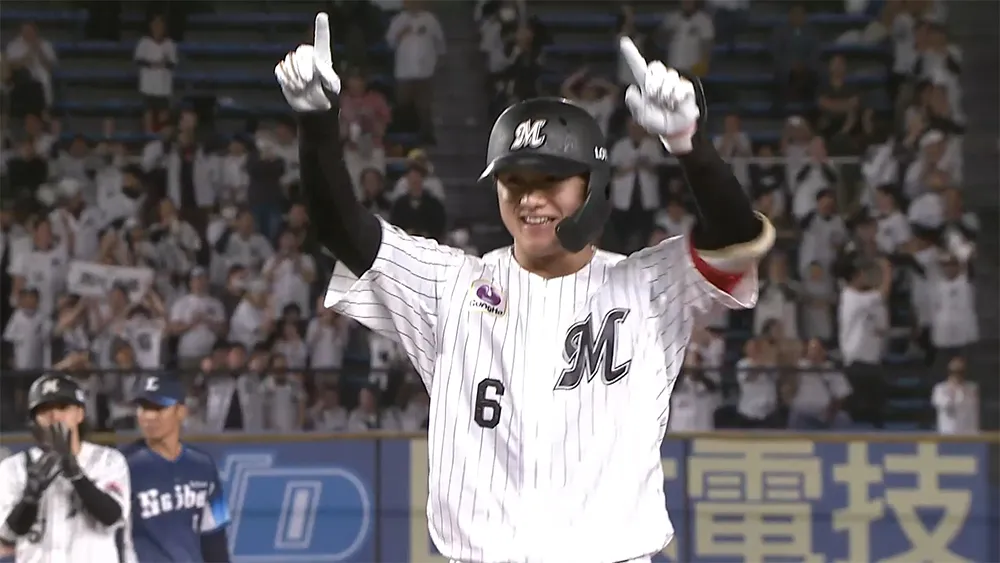
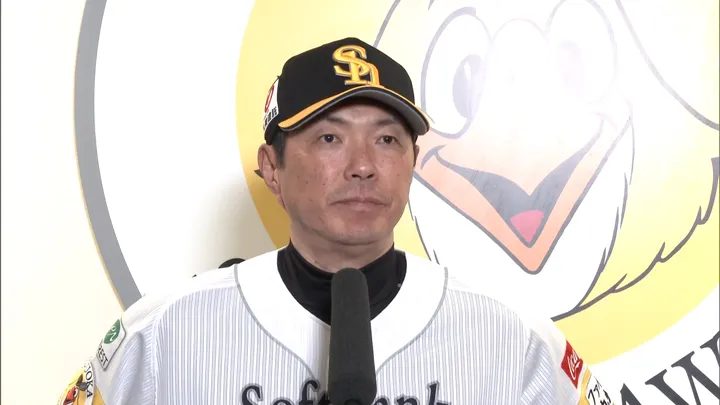
I think it was good because not getting injured is the bare minimum requirement.
Lotte's Shunsuke Nakamori played for a full year this season, his sixth as a professional, without any major absences, appearing in 42 games and pitching 41 1/3 innings with a record of 7 wins, 1 loss, 19 holds, and an ERA of 2.40.
Last season, Nakamori boasted outstanding stability with a record of 2 wins, 2 losses, 10 holds, 5 saves, and an ERA of 1.23, pitching 29 1/3 innings across 25 games in the first half of the season using his 150 km/h+ fastball and fork as weapons; however, although he made his first All-Star appearance, he had no first-team appearances after the All-Star break due to lower back pain.
This season, on March 18th in a Rakuten Eagles minor league game, he made his first regular season appearance for the farm team after returning from back pain. He threw 14 pitches in one inning, 13 of which were fastballs. Regarding the reason for his fastball-heavy pitch selection, he explained, 'It is part of the preparation for competing in the first team; in my case, I cannot compete unless my fastball improves. Even if the batter is waiting for it, I have to get it back to a level where I can get fouls, swings and misses, or adjust the count.'
He broke Atsuki Muto's bat, and regarding the output of his fastball, he revealed, "My condition is steadily improving. I think it will get even better in my next appearance, and I believe things are progressing smoothly."
The first-team mound is where results are required. Looking toward his return to the first team, he looked ahead and said, 'Since I injured my lower back last year, I'll be monitoring its condition. As long as there's no recurrence, I believe I can compete, while also taking care of other areas like my shoulders and elbows. I think it will be possible thanks to the support of many people. In order to compete on that stage (the first team), I want to face each challenge one by one while enlisting the help of various people.'
Even after that, his speed was not increasing much, staying around 145 km/h in farm team appearances, but in the Orix Buffaloes second-team game on May 2, his fastball reached a maximum of 149 km/h, and his speed returned with every fastball thrown being 145 km/h or faster.
On May 4th, he was promoted to the first team for the first time this season, and made his first appearance of the season in the game against Orix Buffaloes that same day, throwing 12 pitches in one inning, closer no hit, strike out one, and closer runs no runs. In his third appearance of the season on May 12th against Nippon-Ham, where he also pitched a scoreless inning, he appeared to be using a pitching form that made full use of his body. When asked about this, he simply said, "That's right." When asked why, he revealed, "I'm conscious of wanting to throw using my whole body." In that game against Nippon-Ham his fastest pitch was 151 km/h, with seven pitches exceeding 150 km/h. When asked if using his body more to throw had anything to do with it, he replied, "Yes, I think that's one of the factors."
Since the Orix Buffaloes' minor league games, his fastball speed has been returning. He himself said, "I think my speed is coming back. Now it's just a matter of monitoring my condition to ensure I don't have to leave the team again and stay injury-free." Regarding the reason for his increased speed, he mentioned, "I think it's because my concerns have gradually disappeared, and thanks to the physical therapists and trainers who looked after me every day," expressing his gratitude to the staff who supported him toward his return.
Regarding breaking balls, last season I often threw the fork after getting ahead in the count, but during this period I have been throwing the slider more often in those situations. 'That's right. I'm using my best pitches more and more. Since I'm a reliever, I only pitch one inning and don't have to worry about facing the lineup a second time, so I just focus on throwing my best stuff to the batter right in front of me.'
In the game against Nippon-Ham on May 12th, in the 9th inning with one out and no runner while leading 2-3, he struck out Chusei Mannami swinging on a 132 km/h slider that broke sharply sideways after a 2-strike count. Reflecting on the play, he said, 'I got ahead in the count, and since I had the advantage, I threw it with the intention that it would be fine even if it was a ball as long as it broke sharply. I think it was a good pitch.'
While he had been pitching in the 7th and 8th innings of winning games, in the match against the Orix Buffaloes on May 17th, partly because closer Rikuto Yokoyama had pitched in three consecutive games, he took the mound in the 9th inning with a 3-2 lead and recorded his first save of the season.
In the game against Hiroshima on May 28th, he pitched on consecutive days for the first time this season, including both the first and second teams. He threw 14 pitches in one inning, allowing no hit, strike out two, BB runs, so pitch itself was not problematic.
"Physically, I felt better on the second day of consecutive appearances, and my body felt more toned. So, I want to make sure I don't let the accumulated fatigue from continuing to pitch back-to-back accumulate. I want to recover properly from scratch."
In the game against Hiroshima that same day, with the score 4-3 in the 8th inning, he got ahead of fastball, the leadoff batter, with struck out, and then struck him out swinging with a 135 km/h fork that dropped from strike zone into the ball zone on the third pitch.
Nakamori was able to throw a satisfying fork, saying, 'It was good. It finally felt like it clicked.' In the game against Hiroshima on the same day, with two outs and no runner in the 8th inning while leading 4-3, he struck out Takayoshi Noma swinging on an 8th-pitch 136 km/h strike zone fork after a 2-ball, 2-strike count. When asked if he intentionally threw into the strike zone to get the strikeout, he revealed, 'I actually wanted to throw that into the ball zone, but it stayed in the zone, so it was a dangerous pitch. However, because I swung my arm through well, I think I was able to get the swing and miss due to the depth, or rather, the difference in speed.'
Since the game against Nippon-Ham on May 12, he had been pitching with a form that utilized his entire body, stating, 'I want to be conscious of using my whole body,' but in the game against the Hanshin Tigers on May 31, he returned to a form closer to last season's, saying, 'I think I am gradually returning to my original style.'
Could this be related to the fact that his original form has also gained speed?
"I was simply using a form that involved a lot of body movement, and I wasn't able to control my body properly. I didn't know where the ball was going. I'm throwing with a form that feels comfortable to me, but I feel like that's causing me more damage." (Interviewed on June 18)
In the game against DeNA on June 14, after getting ahead of the leadoff hitter Atsushi Katsumata with two strikes in the 7th inning while leading 4-2, he retired him on a first-base grounder with a 137 km/h fork on the third pitch; since that June 14 game against DeNA, he has returned to a pitch style similar to last season, using only two types of pitches: the fastball and the fork.
It's close to my ideal. I'm getting the count with my fastball and then using the fork, but I think the best thing is being able to get them struck out. I'm not getting many of those yet, so I think there's room for improvement. (Interviewed on June 18)
In the game Rakuten Eagles on June 19th, it appeared that he spent more time lateral when pitch than usual.
"I think it's good if the horizontal time appears to be long, but personally I don't consciously think about it that much. If it appears that way to others without me consciously thinking about it, then I think that's fine."
Given the high risk of injury, he's returned to a form close to his original one, but is his body actually okay?
"There isn't just one cause of injury; it's a combination of various factors. I'm working on improving each of those things one by one, so I'm trying to become a new person. If I had the same body and the same form as last year, I would just repeat the same mistakes. I want to re-examine things like the movement of my hip joint and other small details and work on them." (Interviewed on July 10)
In the game against Rakuten Eagles on June 19, with two outs and runners on first and third in the 7th inning, 8-4, Fumiya Kurokawa swung and missed on the first pitch at 150 km/h outside fastball, the second pitch at 151 km/h outside fastball, and the third pitch dropped from the 135 km/h strike zone to the ball zone at fork and missed. struck out was a fastball that closed in at fork and struck out at the .
"I think that fork was good because it was at a good height and on a good course."
In the game against Nippon-Ham on July 8, when he took the mound in the 8th inning with the score 2-7, the fifth fork he threw to Yua Tamiya a strike, was clocked at 140 km/h. The speed of fork was 3 or 4 km/h faster than usual.
"I'm trying that out, or rather, I'm trying out a splitter type, side-spin fork. It's not fork I originally threw, so it's more of a trial run. I'm hoping it will work."
In the game against the Rakuten Eagles on July 23, with a 3-1 lead in the 7th inning and one out with runners on first and second, the 7th pitch—a 137 km/h fork on the outside that struck out Ryosuke Tatsumi swinging on a 2-2 count—was excellent. Also impressive was the 135 km/h fork thrown to Ryoma Yamanaka in the game against the Orix Buffaloes on July 25, with a 3-4 deficit in the 7th inning and two outs with a runner on first; it was the second pitch after a 1-strike count that dropped from the strike zone into the ball zone to induce a swing and miss.
Since there have been many cases where batters can lay off the fork, I thought it would be good to have a ball that can get a count even when it reaches a full count. Therefore, I started throwing a small slider again, and I want to throw it while discerning the batter's strengths and weaknesses.
While his pitch selection had mainly consisted of fastballs and forks, he returned to a style that mixed in sliders again starting from the latter half of July. Regarding those sliders, in the game against the Orix Buffaloes on July 25th, with the score tied 3-3 in the 7th inning and no runners out, he threw a slider at 139 km/h—faster than usual—to get Keita Nakagawa to fly out to left on a 2-ball count. In contrast, in the game against Nippon-Ham on August 1st, with the score tied 3-3 in the 8th inning and one runner out, the slider he threw as the third pitch for a foul against Kotaro Kiyomiya on a 2-ball count was 131 km/h.
According to Nakamori, he differentiated between the sliders he threw, using a "small slider" to get Nakagawa out and a "large slider" against Kiyomiya; in an interview on August 4, he muttered about his slider, "It's okay. It's not like it's incredibly good."
fastball reached a season-high of 153 km/h in the game Rakuten Eagles on July 23rd, and 17 out of 18 of fastball have exceeded 150 km/h, indicating an increasing number of appearances where he is clocked at 150 km/h or higher.
However, Nakamori was not satisfied with the balls he was throwing, stating, "Numerically, I think the velocity is there, but the quality and metrics of the ball aren't that good. It's not a ball that can get swings and misses, and while it's necessary for setting up the count, I've been trying things like using other pitch types where I used to throw mostly fastballs while watching the batter's reaction. Since my fastball still isn't the pitch I want it to be, I'm just managing to get by for now."
In the game against the Orix Buffaloes on July 25th, with one out and no runners in the 7th inning while trailing 3-4, he threw a 117 km/h curveball on the first pitch to Haruto Watanabe for the first time this season in the first team, but that was also related to using a different pitch type while observing the batter's reaction. Looking at his subsequent appearances, his pitch selection in the game against the Orix Buffaloes on August 9th and the game against the Softbank Hawks on the 13th was primarily centered around breaking balls.
Regarding the fork, in the game against the Seibu Lions on August 4th, with a 5-3 lead in the 7th inning, he struck out the leadoff hitter Takuya Hiruma swinging with a 140 km/h fork on a 1-ball 2-strike count that showed a great drop from the strike zone to the ball zone. In the game against the Orix Buffaloes on August 9th, with a 4-2 lead and one out with a runner on second in the 7th inning, he struck out Ryoto Kita swinging with an inside 139 km/h fork on a 2-ball 2-strike count that also had a great drop from the strike zone to the ball zone.
Ultimately, I am a forkballer—or rather, a pitcher who gets swings and misses with vertical movement—so I think batters will be conscious of that once they are in a two-strike count. Even so, I am pitching to hit the right spots while making sure to mix in my slider and fastball effectively.
In the game against the Rakuten Eagles on August 20, with a score of 4-1 in the 7th inning, he took a called strike against the lead-off hitter Daisuke Nakashima with a 127 km/h outside slider on the second pitch after one ball. Then, with a score of 4-3 and two outs with no runners in the 7th, he took another called strike against Itsuki Murabayashi with a 130 km/h inside slider on the first pitch, demonstrating his ability to throw sliders to the outside against left-handed hitters and to the inside against right-handed hitters.
Basically, I don't think left-handed hitters are waiting for a ball coming from the outside on the first pitch. Ideally, I want to throw pitches they aren't expecting, or use pitches they aren't waiting for to manage the count. It's also ideal to challenge them with power using fastballs to get fouls and set the count. On top of that, I think I've been able to throw the slider to the outside against lefties into good spots lately.
Since around mid-August, I stopped throwing the fast slider that I call the 'small slider.' Since the fast slider is numerically similar to the fork, and I couldn't differentiate them well, I decided to use my specialty fork instead. Recently, I've also been trying to throw a one-seam fastball to the inside against right-handed hitters. I think just making the batter aware of it will prevent them from stepping in, which should make the outside pitches feel wider for right-handed batters. Although Kurebayashi hit a home run off me, I want to keep using it more and more from now on. I hope to use it in situations where it's effective.
Since entering September, his fastball usage has been low: in the Rakuten Eagles game on the 9th, he threw 5 pitches in one inning with zero fastballs; in the Softbank Hawks game on the 13th, he threw 17 pitches in one inning with 5 fastballs; and in the Nippon-Ham game on September 15th, he threw 22 pitches in one inning with 9 fastballs.
Under those circumstances, in the Orix Buffaloes game on the 22nd, 18 out of 27 pitches in one inning were fastballs. In the 7th inning with one out and runners on first and second while trailing 3-4, he threw a foul on the 4th pitch to Ryo Ota after a 1 ball, 2 strike count. Then, in the 7th inning with two outs and a runner on second while trailing 3-6, his 2nd pitch to Kotaro Kobayashi was a ball after a 1 ball count, but it clocked in at 155 km/h, tying his personal best.
In the game against the Orix Buffaloes, there were many fastballs, but he said, "Right now, the theme is output," and regarding the fastballs, he revealed, "The speed of the straight pitches has increased, but conversely, my control has been poor lately. I think my command, or rather the adaptability and responsiveness I mentioned before, is still lacking."
In the game against the Orix Buffaloes on the same day, with one out and runners on first and second in the 7th inning trailing 3-4, he struck out Ota swinging on a 138 km/h inside sinker-type pitch on a full count of 3 balls and 2 strikes. Looking back, he said, 'It went to a good spot, but I was constantly putting myself in bad counts during that game. I think that is an issue to address.'
In the game against the Seibu Lions on September 25, with a 4-2 lead and two outs in the eighth inning with a runner on second, the second pitch thrown to Nevin—an inside 135 km/h fork that resulted in a swinging strike—was excellent. Reflecting on the performance, he said, 'That one was good, but for the next pitch, I intended to throw it toward the base but it ended up in the strike zone. I need to minimize mistakes as much as possible and focus on pitch location. Speed is important, but ultimately control is everything, so I want to work while using my head a bit more.' As he noted, the fork that resulted in a called struck out after two strikes was a 134 km/h pitch in the strike zone.
In September, he pitched 8 innings across 8 games, recording 10 strike out, with a strike out rate of 11.25. "I decided to try raising my arm angle about a month ago, and since I am originally a fork bowler, I have started to get more struck out by being able to get swings and misses there. Because I changed my form a bit, or rather changed the angle, there is some inconsistency in both my breaking ball and fastballs, so I need to practice that."
In October, he pitched 2 innings across 2 games, recording 3 strike out with a strike out rate of 13.50. After the regular season ended, he was selected for the Japan national team for the 'RAXUS Asia Professional baseball Championship 2026' starting on the 12th.
In preparation for the battle with Samurai Japan, during the autumn practice held at Zozo Marine Stadium in October, he worked hard on his training, stating, 'The season is over, but there are still games left, so I want to make sure I don't get injured. I want to keep my body moving and practice so that I can level up for next season rather than just focusing on those games.'
In an interview on September 28th, he mentioned, "During the off-season, I want to focus on physical training and technical practice." Now that he has been selected for Samurai Japan, one wonders if he is changing the off-season training plan he had originally envisioned.
Since the season is over and I can't let my performance drop, there is a bit of that to deal with, but I'm looking at it alongside my off-season schedule. I think it was probably a good thing that there was a game.
Regarding his off-season training after the tournament, he said, "I plan to continue training consistently and prepare so that I can practice to my full capacity in January."
With the Samurai Japan games, this season has been longer than for other players, but I want to finish without injury and start preparing for next season.
Interview and text by Yuta Iwashita