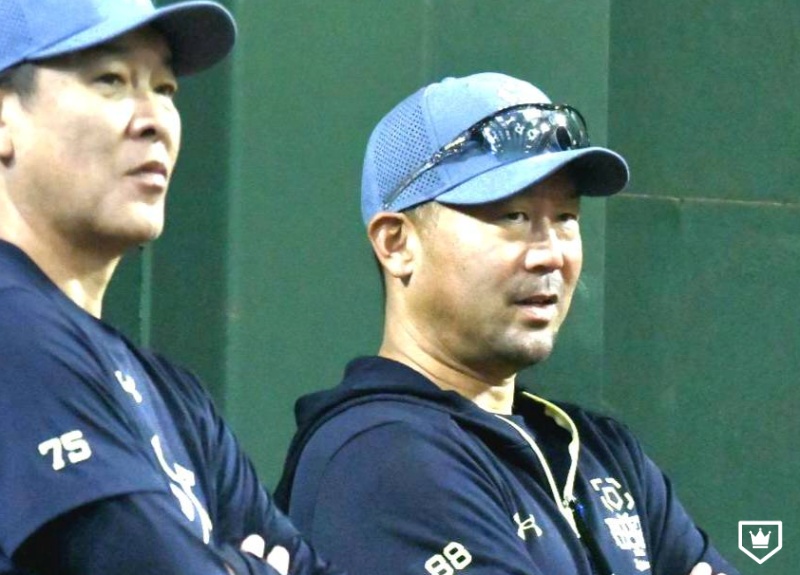
Former Rakuten Eagles manager Hajime Miki, who has taken over as the new head coach of the Orix Buffaloes, is demonstrating his characteristic communication skills at the ongoing fall camp.
I truly believe that I must thoroughly understand the Orix Buffaloes myself. Since there are many young coaches, talking about various things will lead to hints, so I want to proceed while maintaining communication. Miki, the head coach, spoke quietly after finishing the third day of camp.
He has been participating in the camp since November 1st, when his appointment was announced. On the third day, he talked with coach Ryoichi Adachi after defense practice, and for over an hour with manager Mamoru Kishida after the overall practice. The previous day, he was seen conversing on the ground with players Ryo Ota, Kotaro Kobayashi, Yusuke Mugitani, and Tomoya Noguchi.
"It's just small talk to say I look forward to working together," he says, but the content of the conversation is a bit unusual. "I ask things like how they view themselves or if they like baseball. Rather than me saying this or that, they actually talk to me quite a bit. I respond with things like, 'Oh, I see. I'll keep a close eye on what I can and do my best to support you, so let's work hard toward next year.'" He finished the conversation with Noguchi with a handshake.
He says there is much to learn even from those younger than him. 'Coach Adachi and I are far apart in age, but he has experience as a player and likely knows many things I don't, and he knows more about the Orix Buffaloes than I do. Hints for practice methods and how to proceed emerge from our conversations. I truly believe that, and I'm not just saying it to sound good.'
Born in Sakai City. During his time at Uenomiya High School, he hit 23 Home Runs and joined Yakult as an infielder as a first-round draft pick. Over 12 years, including his final active year with Nippon-Ham, he appeared in 359 games, recording 59 hits in 303 At Bats, 2 Home Runs, and a .195 batting average, but he has extensive experience as a coach. After retiring as a player, he served as the first-team infield defense and base running coach for Nippon-Ham, and for Yakult, he was the second-team infield defense and base running coach, first-team strategy coach, first-team head coach, and second-team chief coach. From 2019, he served twice as the second-team manager and first-team manager for the Rakuten Eagles. He is a theorist who teaches base running by listing seven key points, contributing to players like Dai-Kang Yang (Nippon-Ham), Tetsuto Yamada (Yakult), and Hiroto Kobukata (Rakuten Eagles) winning stolen base titles. He was invited to the Rakuten Eagles and Orix Buffaloes—teams he never played for—due to his character and track record as a coach. Hidemasa Tanaka, his manager at Uenomiya High School and a member of the Japan High School Baseball Federation's Technology and Promotion Committee, says he cannot forget Head Coach Miki's actions after a youth baseball game. 'We lost the game, but he took the lead in cleaning the dugout and tidying up the equipment. Seeing this made me decide to recruit him.' Among the members who won the spring Koshien, he was in the dugout from the summer of his first year and also served as captain. Although they did not make it to Koshien, Tanaka says, 'Even when we were at a disadvantage, he led the team by being the one to speak up. Three players from that same grade went pro, but I had decided he was the one with the captaincy to pull the team together.'
Even after becoming a leader, he considers his experience in various positions to be a strength, saying, 'I am grateful. Thanks to many people, I have been able to have truly valuable experiences.' This is his second time serving as a head coach assisting the manager. He says, 'It is not just the manager who has it hard; I also understand the difficulties and hardships of being a position coach. Thanks to having experienced the difficulties of being a manager myself, I understand them in my own way.' Furthermore, he described his ideal image of a head coach, stating, 'I believe one of the roles of a head coach is that you must know the team and you must keep yourself informed. Additionally, you must make proposals while showing an understanding of the baseball the manager wants to play. It is also important to act as a bridge and maintain balance between the manager and the coaches by properly absorbing what the coaches want to do and implementing it with the players.'
What he demands of the players is the thorough execution of the mundane. 'Doing the obvious things as a matter of course might be the most difficult task of all. The higher the quantity and quality of what can be done as a matter of course, the stronger the organization becomes. I believe the work and awareness required to raise that quality are extremely important,' he said, calling for a further increase in the quality of everyday tasks.
During his time as the Rakuten Eagles' minor league manager, he was called 'Miki Mama' by fans after mentioning on the team's YouTube channel that he felt 'like a mother to each and every player.' He said, 'My appearance isn't that of a mother, but I don't think my feelings, mindset, or style will change. I truly love baseball, and right now I have strong passion and affection for the Orix Buffaloes team as well,' indicating that he intends to approach his role with that same 'motherly' heart.
Entering a new environment at the age of 49. 'Having been approached and asked to be a source of strength for the team, the sense of responsibility regarding how much I can meet those expectations and deliver what is required is quite significant. It feels like a battle between the hope of improving the team and the anxiety of what might happen if things don't go well.' His ability to view himself objectively and express his true feelings is likely part of his charm. From a bottom-half finish to aiming for the first championship in four years, expectations for Head Coach Miki's skills are rising.
Interview and text by Masaki Kitano