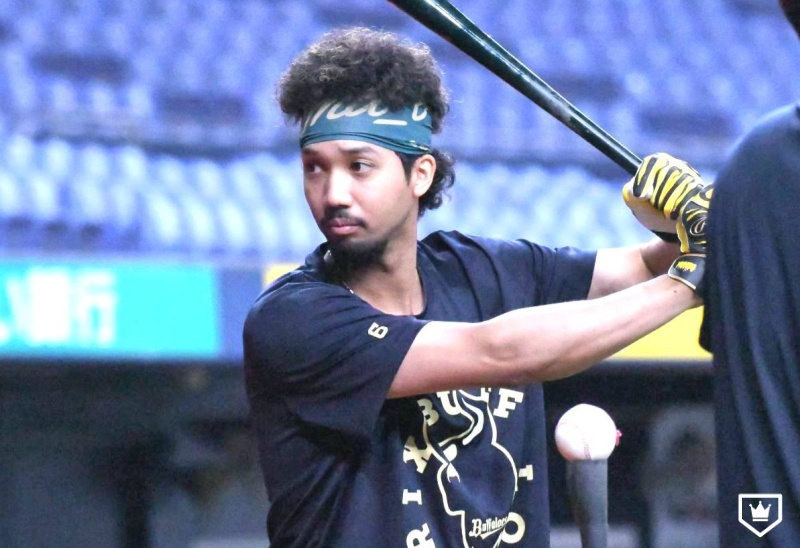
Orix Buffaloes infielder Yuma Mune, who achieved over 100 hits in a season for the first time in three years and saw a resurgence in his batting, has begun working on handling high pitches, which he struggles with, as he heads into his 13th professional year.
“I knew it was a weak point, but if I can master this, I will be able to hit .280 consistently. That would be an incredible feat.” On October 1st, ahead of the final game of the season, Mune explained his practice routine after finishing individual drills following the team practice at Kyocera Dome. Mune, who was the last one left swinging the bat, was hitting balls off a high tee set up by assistant staff member Shun Urushido into the net, focusing on keeping his left side from collapsing. This was his way of addressing high pitches, something he had been working on since the latter half of this season.
Mune joined the Orix Buffaloes as an infielder from Yokohama Hayato High School as a second-round draft pick in 2014. Although he once converted to an outfielder, he established himself at third base in 2021, his seventh year. As a player who possesses the three key traits of speed, good hitting, and strong defense with a powerful arm and resilience at the bag, he contributed significantly to the three consecutive league championships and the Japan Series title starting from 2021, and won both the Golden Glove Award and the Best Nine award for three consecutive years starting in 2021.
However, starting from 2024, he struggled with severe fluctuations in his batting performance for two consecutive years, and his appearances dropped below 100 games. Entering his 12th professional year with the mindset that "if I can't hit, I won't be used," he played in 134 games and reached the regulation number of plate appearances for the first time in four years, despite his batting average remaining at .245. He recorded career highs of 14 Home Runs and 65 RBI. His RBI total was the highest on the team, his Home Run count was second only to Kotaro Kobayashi (18), and his 6 stolen bases were also second on the team following Haruto Watanabe (18).
His approach to high pitches was based on advice from Shuhei Fukuda, who was his teammate until last year. 'When we had a meal about a month ago, he told me, "You can't hit high balls, can you?" Even now, he watches footage of me and sends me messages on Line saying things like "You're looking good" or "Maybe you should try this." At the time, I just replied, "No, not really. I'm working on this right now." But he was so desperate to convey the importance of hitting high pitches to me. That's when I started thinking that maybe it would be better if I could hit them.'
Mune was aware of it himself. In the data analysis by course, the probability of him hitting high balls was shown in "blue," indicating the lowest success rate. Even so, he didn't feel much like correcting it, thinking, "I'm a low-ball hitter, so I should just hit the low ones." His reasoning was that "hitting high balls in practice takes a lot of physical strength. The bat is heavy, so if you swing normally, you end up swinging low," and he believed that focusing on his strengths would yield better results than fixing his weaknesses. However, Fukuda-san's serious words changed his mind. "It's fine to keep the low balls as a strength, but that would also be a way of running away. Saying it's okay if I can't hit them is just affirming my inability to hit. I realized I needed to face myself properly."
Since then, he has raised the height of the tee and focused on hitting balls toward left-center during batting practice. 'In my case, my hits toward left-center have become weak. If I just wanted to hit a good ball in practice, I could hit it toward right-center, but I want to be able to hit firmly toward left-center as well. If I'm in a state where I can hit toward left-center, it means I'm also in a state where I can pull the ball,' Mune said. To hit a ball that pierces through left-center, he needed to be able to handle high pitches. 'I don't necessarily need to chop down on the high tee-ball from above, but I have to create a condition where I can hit high balls solidly. That's where the pitcher's strongest balls come, so if I can repel those, I can handle anything.' By overcoming his weaknesses, he is creating a new version of himself.
The effects are reportedly showing. 'At first, I didn't understand the method at all, but I've started to get the hang of it. Even in games, balls that used to be fouls are starting to fly forward and turn into hits. If I keep myself in a state where I can always crush the high pitches, the bat is heavy enough that I can swing at the low ones anytime.'
"The number of home runs will increase, and I will be able to hit .280 consistently. Over this past year, I've seen both my good side and my challenges, and I feel like there is nothing but growth ahead. I'm looking forward to seeing what I can do. I'm really excited. I can't help but enjoy it. I have a sense that I am stepping up to the next level." After two years of struggling, Yuma Mune, who opened up new horizons without making excuses for himself, will evolve even further.
Interview and text by Masaki Kitano
![Ryoya Kurihara won two batting titles: 2026 Pacific League Title Winners [Batting Category]](https://media.insight.pacificleague.com/webp/RXiiCj0UjQrdMefevwrfWduFLVdZlJLIQqiAy0oe.webp)
![Kaima Taira achieves an NPB first: 2026 Pacific League title winners [pitcher category]](https://media.insight.pacificleague.com/webp/KcRA9GAQscgF0YYcL93G1blJ2qH8vco2MHyJKwKg.webp)